
After making her feature debut as an actress in Bosta (2005), a film about a travelling dance troupe and their eponymous bus, Nadine Labaki went on to direct her own films, in which she also stars, always as a seductive but independent-minded character. She began 4 years ago with Caramel (Sukkar banat), a romantic comedy set in a beauty salon. The film focused on friendships and sisterly support among the regulars at the salon. Labaki’s second feature, Where Do We Go Now? (Et maintenant, on va où?, 2011), takes place in a village, far from Caramel‘s setting in urban Beirut, but the film is similarly female-centric. As in Caramel, the female characters tend to be direct in their interactions with each other, trading cheeky insults, but also putting their heads together to overcome problems created by the men in their lives. Not having a salon to meet at, the women of the village gather in each others’ kitchens, or after hours in the bar owned by Madame Amal (Labaki), a single mother.
The principal problem in Where Do We Go Now? is that the village is half Christian, half Muslim. Although all of the villagers have learned to live peacefully together, any perceived insult to one religion or the other risks destroying the equilibrium. The village’s women refuse to let this happen: when they learn of Christian-Muslim tension in other parts of the country, they will do whatever is necessary to prevent the men from finding out about it. While their motivation is deadly serious, the idea of women banding together to enforce peace is both funny premise and an ancient one, recalling Aristophanes’ Lysistrata in which women go on a sex strike to end a war. The methods adopted by the women in Labaki’s film are more diverse: one method actually turns Lysistrata on its head, as the women invite Ukranian strip-tease artists to the village to distract the men. The film’s dialogue is also both witty and original, and impeccably delivered by a cast which included many non-actors, most likely playing roles that were familiar to them from real life. The audience at the screening I attended were obviously having a grand time. This corresponds to the film’s reception at the Toronto International Film Fest: Where Do We Go Now? took the Audience Award, a prize that has in the past gone to such subsequent success stories as Amélie (2001), Slumdog Millionaire (2008) and The King’s Speech (2010).
For me, the film did not quite live up to the standard set by Caramel. Taking place mostly in one salon on one street in Beirut, the viewer could quickly become familiar with the space in Caramel. In Where Do We Go Now?, there was not an overall sense of space. Although there were a few long shots of the village from the outside, the hills that surrounded it, and the precarious stone bridge connecting it to the outside world, the film did not develop a clear sense of the village’s geography, so that the action seemed to take place in a disparate set of interiors (church, mosque, bar, and a couple of homes), as in a stage play. Similarly, while Caramel centred mainly on a group of 3 friends, Where Do We Go Now? had a much larger cast, making it difficult to get to know any of the characters very well. While the women’s different schemes were funny, there was not a clear sense of direction to the film: it felt more like a series of gags. The love story between Madame Amal (a Christian) and her sexy decorator (a Muslim) could have served as a unifying theme, but was not fully developed.
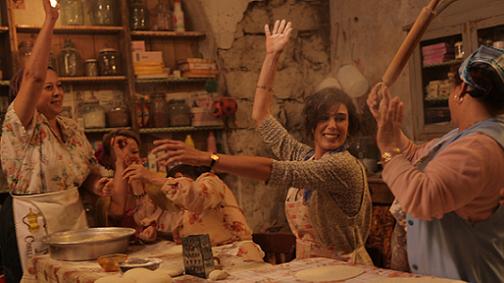
Another notable strength of the film was its three musical set pieces, all marked by different moods. The opening was the most self-conscious, and felt like it could have come straight from Herzog’s Pina (2011): all of the film’s female characters, dressed in black, limp and sway towards the camera, thumping their breasts, in a dramatic funeral cortege. The film’s next musical scene is much happier one, marked by white rather than black. While reminiscent of Bollywood insofar as it abruptly introduces a romantic song and (sort of) dance, it is realistically integrated as Madame Amal’s dream of a romance with her decorator. The film’s final set piece is also realistically motivated: as the women work together in the kitchen, preparing a selection of very special pastries for the men, they sing a very catchy song.
In spite of the narrative and spatial flaws in Where Do We Go Now?, Labaki should be commended for having made this film. Aside from being immensely enjoyable for the audience, the film takes a daring approach to inter-religious tension. It suggests that most people have so many concerns in common (love, family, food, entertainment) that it is natural for them to understand each other and get along—it is those with too much aggression in their systems who seek petty pretexts for a fight.


