
Audiences and critics alike seem to have a soft spot for nostalgia of late: witness the superlative praise lavished on “The Artist” (2011), which did little more than copy silent films of the past. The overwhelming response to Woody Allen’s “Midnight in Paris” (2011) is also hard to explain as anything but nostalgia. Owen Wilson plays Gil, a writer who visits Paris and discovers a way to travel back in time to meet literary and artistic greats of the 1920s and the Belle Epoque. Having ridiculed Allen’s tourist postcard of London in “Match Point” (2005) and “Scoop” (2006), audiences delighted in the consummate cliché of “Midnight in Paris”: an idealised past brought back to life. The irony is that Allen’s film satirizes this rose-tinted vision of the past: Gil seems out of place in the 1920s, coming across as a wimp and a dreamer next to the manly Hemingway and the confident F. Scott Fizgerald. Meanwhile, Gil’s flapper friend (Marion Cotillard) just can’t see what he loves about her era: she herself longs for an earlier golden age.
As Allen’s film humorously points out, there will always be people who say that things were better before. Still, it’s hard not to look to the financial crisis as a partial explanation for this longing for the past in contemporary cinema. Some ten years ago, “Amélie” broke box-office records with a strangely old-fashioned vision of Paris set in 1997. While that film was clearly influenced by classic French cinema of the 1930s, it maintained a contemporary feel through its innovative style, incorporating cutting-edge digital effects. Comparing the French films that made a splash in 2001 and 2011, setting the freshness of “Amélie” against the pastiche of “The Artist,” it’s hard not to succumb to nostalgia myself.
Allen’s latest film, “To Rome With Love,” can be said to combine the approach of “Midnight in Paris” and “Amélie.” As in his previous film, there is time travel, of a sort: John, a middle-aged architect (Alec Baldwin) attempting to locate the Trastevere residence of his student days, runs into Jack (Jesse Eisenberg), currently studying to be an architect, and seemingly living in the very same spot. Has John actually met his younger self? The supernatural element is not clear-cut, as Jack and his lovers wear contemporary clothing styles and have mobile phones: it only seems uncanny when John begins to intrude on the young people’s conversations with advice and predictions, like a ghost from the future. In a second storyline, Woody Allen himself plays Jerry, a father intruding on the lives of his daughter’s prospective Italian in-laws. Recently retired from the music business, Jerry’s instincts are irresistibly aroused by the Italian father’s undiscovered talent as an opera singer. Here again, while the story is ostensibly set in the present, it could have taken place anytime in the past half century or so.
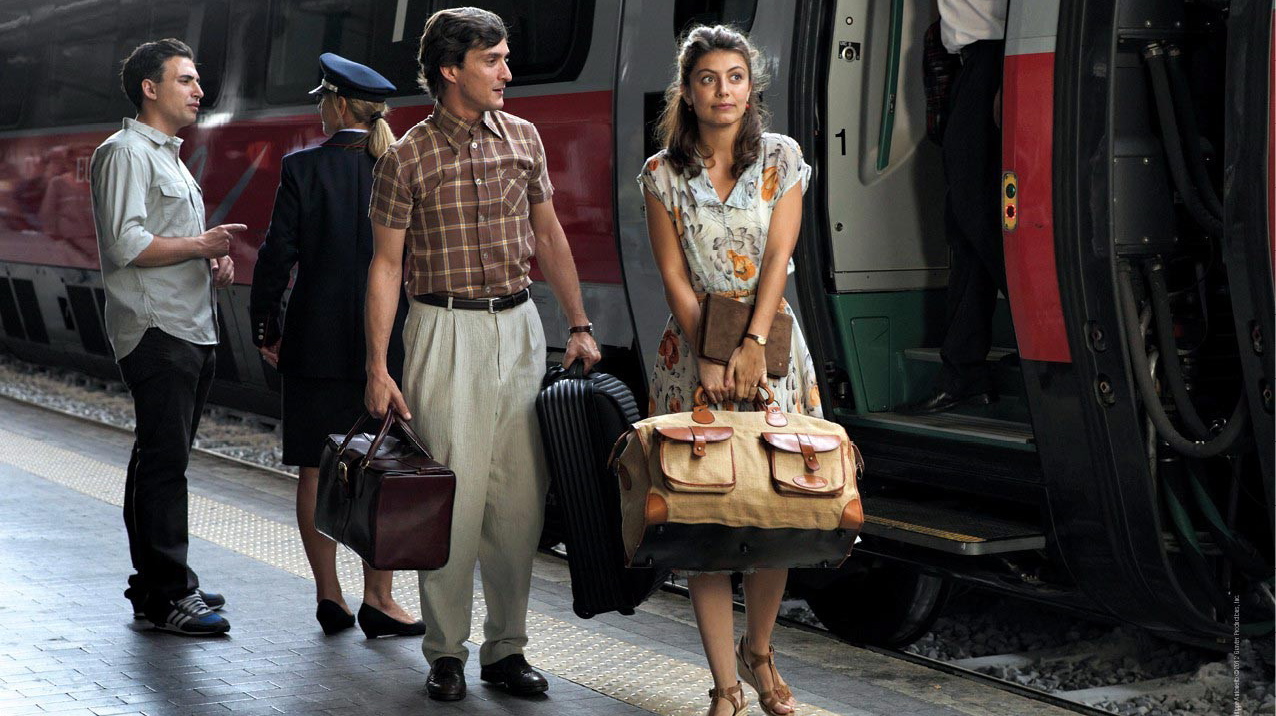
Stranger still are the film’s other two storylines. One features a timidly excited newlywed couple who leave their provincial life for Rome so the husband can take up a lucrative position in the family business. The other storyline centres on Leopoldo Pisanello (Roberto Benigni), an average Italian office worker and family man who becomes a celebrity overnight for no apparent reason. In both of these storylines, even if the characters carry mobile phones, their traditional suits and dresses wouldn’t be out of place in a 1940s or 50s film: perhaps this is Allen’s subtle homage to the Italian neorealist period. Yet ‘realist’ this film certainly isn’t: like Allen’s London-set films, “To Rome With Love” takes in every tourist hotspot. Like “Amélie,” it does its best to satisfy the foreigner’s fantasies of the city, bathing the contemporary city in a golden light and populating it with clichés: in the Roman context, this means mopeds, Fiat 500s, exquisite food, impeccable clothing, romance with sexy locals, and apartments with postcard views. That said, Allen’s film also includes less familiar spots (countryside ruins, modern architecture, and old Roman baths by night), and incorporates less glamorous realities, such as frumpy housewives and the contemporary media scrum.
Jumping freely among its storylines, “To Rome With Love” is more interesting than the linear “Midnight in Paris,” where nightly time travel quickly became predictable. But one of the complaints against “To Rome With Love” is that its four storylines never intersect. The fashion for films with intersecting storylines seems to have started with Babel back in 2006. Initially, this approach was interesting because it felt fresh and new; after its novelty wore off, it was still a good way to pursue more than one narrative strand without losing the film’s sense of unity. Of course, there is more than one way to create a unified effect. The storylines in “To Rome With Love” are united, as the title suggests, by their common setting in Rome. They are also united visually by the use of red, from the red cars and mopeds that add a splash of color to every street, to the red clothing of the female characters (most memorably, the provocative red mini dress of Anna the prostitute, but also the shirts of the more boyish American girls). Crucially, the stories are united by the element of fantasy. As mentioned, there is the architect’s trip back in time; Pisanello’s sudden fame has the absurd, unreal quality of a dream; Jerry’s unorthodox approach to launching an opera career is also comically absurd; meanwhile, the newlyweds in Rome both encounter unlikely opportunities to fulfil their sexual fantasies. Just as “Midnight in Paris” implicitly critiqued nostalgia for a golden age, in “To Rome With Love” Allen self-consciously satirizes our fantasies of the Eternal City.


