
The London Iranian Film Festival is only in its second year, but already it boasts an enchanting and highly professional-looking trailer, as well as a varied line-up of films that blast open the old 80s stereotype of Iranian films as being superficially sweet studies of childhood in which social commentary was necessarily covert. It is of course important not to lose sight of the real censorship and official bullying of filmmakers that takes place in Iran, the most infamous example at the moment being Jafar Panahi. The London Iranian Film Festival has certainly not forgotten Panahi: it screened his new documentary, This Is Not a Film (In Film Nist, 2010), which records his struggle against the 6-year prison sentence and 20-year ban on filmmaking imposed by Iranian authorities last December.
The festival demonstrates the inspiring variety of contemporary Iranian filmmaking. Obviously, this year’s festival had to include A Separation (Jodaeiye Nader az Simin, 2011); although it already had a general UK release over the summer, it is a film that can be watched again and again, both for its acting and its intricate layering of truth and deception. The festival also included films which most London audiences will not have encountered before: A Very Close Encounter (Barkhord-e Kheyli Nazdik, 2010), a thriller about the criss-crossing relationships linking two women involved in a car crash, and Please Don’t Disturb (Lotfan Mozahem Nashavid, 2010) a low-budget comedy about an elderly couple afraid of the repairman, a pickpocketed cleric, and a woman threatening to leave her abusive television-personality husband.
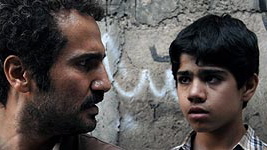
I attended a screening of a film that, from its description, seemed to correspond more to the lyrical, child-focused Iranian films of the 1980s. The Other (Digari, 2010) concerns Reza, a boy of about 10, who lives with his recently-widowed mother. Reza goes on a trip to Tehran with Mr. Ebrahim, his father’s old friend and business partner, to sell the business’s van. Reza’s uncle is forcing Ebrahim to sell the van, but doesn’t trust him and so sends Reza to supervise. Mr Ebrahim, himself a widower with a 6-year-old daughter, would clearly like to marry Reza’s mother, but the uncle is opposed to the match. Reza himself is initially hostile towards Mr Ebrahim, but they grow closer over the course of the trip.
The Other is director Mehdi Rahmani’s first film, and in many ways it shows. The film’s technical quality is lacking: its colours are at once saturated and washed out, making the film look like it was made in the 1970s rather than just last year. This, combined with drab, worn-out surroundings means that shots of visual appeal are rare. The script, too, is not quite as unified as it could be: while the dialogue feels largely authentic and moderately interesting, it lacks momentum at times. The exposition is also a little confusing at first: luckily, the film’s plot and characters are restricted, so just by patiently listening to the characters, it becomes clear what is going on and what is at stake—rather as in real life.
With such reservations, I felt like I wasn’t really enjoying the film at the time. Over the hours and days following the screening, though, many themes and images kept coming back to me, making it clear that for all its roughness, this was a film that presented an authentic picture of present-day Iran, and had something serious to say about its social structures. It may have been the austerity and hardship that the film presented that provoked my initial negative reaction, as much as the film’s artistic weaknesses.
In retrospect, it is easy to see why this film won Best Children’s Feature Film at the Asia Pacific Screen Awards last December. On the one hand, The Other will have cross-generational and cross-cultural appeal through its focus on the difficult relationship between children and any adult who attempts to stand in for a missing parent. On the other hand, the film examines Iran’s particular situation with regard to women’s marital rights: aside from the example of Reza’s mother, who can’t remarry until her brother-in-law says so, Reza and Mr Ibrahim encounter a troubling example of family strife in the room next door to theirs at the hotel in Tehran. While The Other can be a troubling film to watch in terms of its portrait of life in Iran, its heartfelt authenticity will remain with the viewer long after the end credits.
For more information about past and future editions of the London Iranian Film Festival, consult their web site: http://ukiff.org.uk/


