
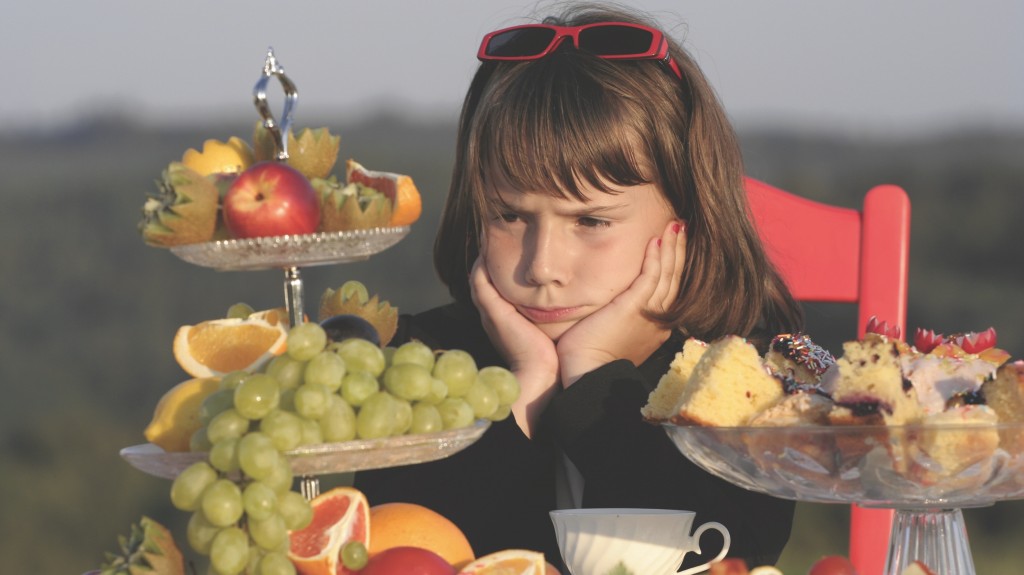
The Magic Tree (Magiczne Drzewo, 2009) is not really about a tree: when the film begins, the tree in question has already fallen down during a storm, and has been used to make a number of different wooden objects. All of these objects have magical abilities, but the largest part of the tree’s powers are concentrated in one object in particular: a chair that can grant wishes, and it is this chair that is the true subject of Andrzej Maleszka’s first feature. The chair ends up belonging to a family of modest means, and starts granting the children’s wishes before they even realise that it has magic powers. When the children wish that their parents could have great jobs and earn a lot of money, they discover that wishes don’t always come true in the way that you would like. For the rest of the film, the children try to undo the consequences of their wish, and at the same time make sure that the chair doesn’t fall into the wrong hands.
The film opens with a promisingly whimsical sequence: a reduced frame and grainy film stock are used to create a retro home movie feel, and a series of shots recount curious examples of wooden objects (pencils, dice, etc) coming to life. Reminiscent of the opening sequence of Jean-Pierre Jeunet’s Amélie (2001), each shot focuses on one event while a voiceover narrator specifies the exact time and location before describing the event itself, quickly but in detail (for example, ‘Poznan, 14th of October, 2004: a wooden clog walks out of a house all by itself, seemingly unconcerned by the stares of passers-by’). The opening leads the audience to expect a similar density of detail, textural invention and slightly ironic wit from the rest of the film. As the opening sequence goes on to explain where these objects got their power, the image fills the entire screen, and the film quality switches to the a crisp, clean modern look which is maintained for the rest of the movie.
Certainly, there is something to be said for the rest of the film’s entertaining silliness, inventiveness, and striking use of colour (red, in particular). But there is a something unnerving about the self-propelling objects we see at the beginning of the film—they are far from having the power of Jan Švankmajer’s stop-motion animation, but nonetheless retain the authentic edge of Eastern European fairytale. This feeling is completely lost as the film goes on. The film replaces these haunting images of objects with overplayed characters, a saturated colour palette and light-hearted comedy. While calculated to appeal to children, such an approach underestimates children’s interest for darker and more dangerous elements in storytelling.
There is, to be fair, a certain amount of creativity in the film, from certain details of character (an aunt who only employs deaf-mute housemaids because she likes quiet and privacy), to the wishes that the children make and the way that they are granted. When their aunt tries to stop them from setting off in search of their parents, rather than wishing that she would help them in their search, the children wish for her to be smaller than them: the aunt is immediately replaced by a little girl. This child with an adult’s attitude and dress sense is not only a source of comedy: the transformation also allows the children and their aunt to develop empathy for each other, and ultimately results in a surprising source of resistance to the film’s otherwise conventional conclusion (the return to an original state of stability).
The often surprising nature of the wishes and the way that they are granted underlines the difference between child and adult logic. More importantly, it also opens the way for potential conflicts which a different wish could have avoided. Strangely, though, having created these conflicts, the film proceeds to resolve them with astonishing speed. The film’s villain is a mean-spirited bully who is in charge of the Augustino fair, a tall bald man in stripy clothing, who strides about on a pair of spring-loaded stilts. With this imposing, unnatural appearance, he could easily have been terrifying, but he typically comes across as weak and powerless. When he attempts to follow the children, he is chased by ferocious animals. When he tries to steal the chair, it actually runs away from him. When the chair finally does grant him a wish to save his life, he is so grateful that he changes his selfish ways, and returns the chair to the children at the crucial moment. I can’t remember the last time I saw a children’s movie in which threats are so easily eluded. Stereotypically anodyne Disney movies contain far more perilous situations, real sadness, and moments where it really seems like the worst is going to happen, and a happy ending is impossible. In The Magic Tree, the audience quickly learns not to bother feeling anxious, as there is never really anything at stake.


