
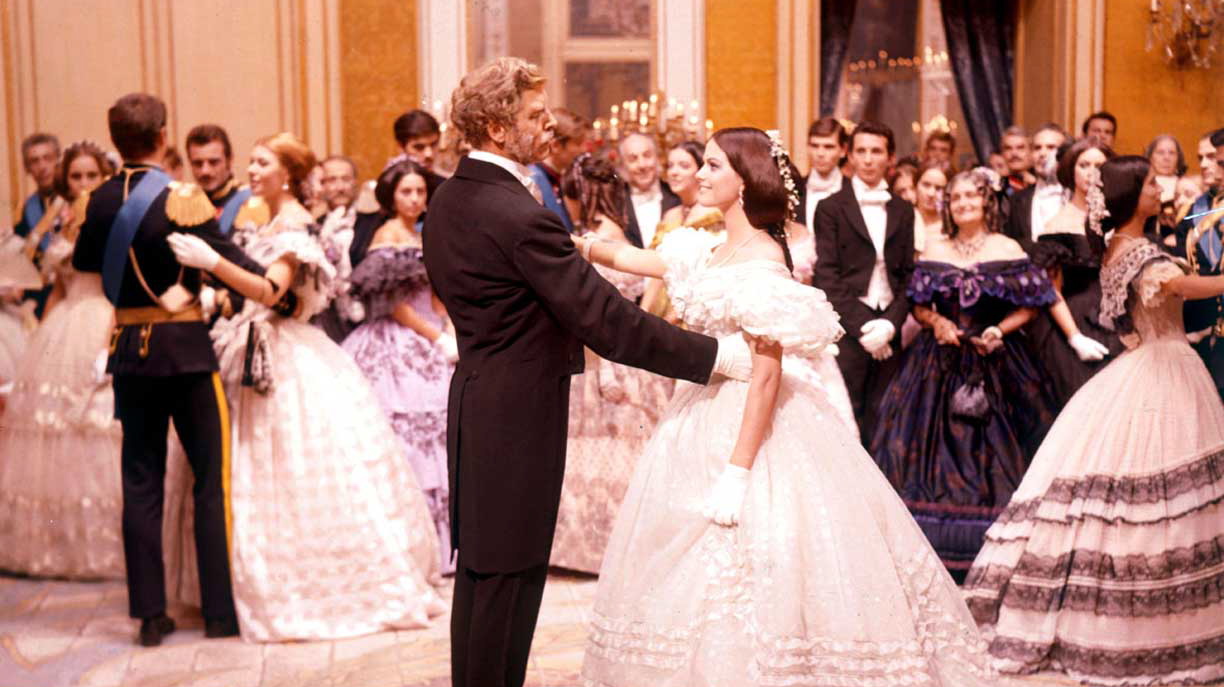
Luchino Visconti’s The Leopard (Il Gattopardo) was made in 1963, but is set just over a century earlier, during the Risorgimento, when Garibaldi fought for Italy to be united into one kingdom, free of foreign control. To give a personal dimension to the changes taking place in the region, the film portrays their influence on one aristocratic family in Sicily. Burt Lancaster plays The Prince of Salina, the family’s grizzled patriarch, who seems to adopt a practical attitude to the changes. As the wealth and influence of his class slowly declines, he sees that it is wise to support unification, progress, and the rise of the middle class. At the same time, his aging but still handsome face expresses a quiet melancholy as he sees that aristocratic traditions of piety, dignity, fastidiousness and seclusion are going to die with him. He is too old to take part personally in his family’s reinvention, and he seems sorry about this too. The family’s male heir is the prince’s young nephew Tancredi (Alain Delon), who embraces politics and a vulgar but beautiful bride named Angelica (Claudia Cardinale): his dynamic life among the general population will be far different than his uncle’s—and perhaps better for it.
Visconti based his film on a novel of the same name by Giuseppe Tomasi di Lampedusa: it is a rare example of a film that rivals, if not exceeds, the achievements of the original literary work, taking a time and setting that a reader might have difficulty imagining, and bringing it beautifully, vibrantly, to life. The film also shows the influence of opera: a restricted set of orchestral leitmotifs intervene regularly; narrative developments feel clearly demarcated as though they were acts and scenes; and abundant long shots allow the audience to take in the action of entire battle grounds, ballrooms, and drawing rooms, as though gazing at a stage set. Yet Visconti skilfully draws on opera without allowing it to take over the film. The Leopard maintains its specificity as a film: static long shots are balanced by elegant camera movements which gracefully deliver the audience into close-up with key characters. Combined with a series of conversations, in which characters discuss their own feelings or speculate on the feelings of others, close-ups of the actors’ powerful expressions manage to re-create the interiority that is so easily lost when adapting a novel for the screen. Rather than looking for artificial ways to make cinema ‘tell’, Visconti makes use of cinema’s superior ability to ‘show’ emotions through facial expression, tone of voice and physical juxtaposition: for example, the contrast between Angelica’s laughter at Tancredi’s lewd army stories, and his former sweetheart’s visible shock, as they sit on either side of the young man at the dinner table.
In an interview at the BFI nearly 10 years ago, Claudia Cardinale recounted what it was like working with two directors on two films at the same time: Visconti on The Leopard and Fellini on 8½. Visconti and Fellini had a completely different working style, and the differences in production couldn’t come through more clearly in the finished films. Where Visconti took a rigorously controlled approach, certain of everything he wanted from the very beginning, Cardinale said that Fellini’s sets were like parties, and his films were inspired by the chaos. While improvisation was forbidden in Visconti’s films, in Fellini’s it was the rule. Freedom and abandon arguably have their place in creating a joyful and spontaneous cinematic experience, but it is hard to imagine Fellini making such a success of a film like The Leopard: Visconti’s sense of calm control fits perfectly with the film’s theme of calm melancholy in the face of inevitable decline.


