
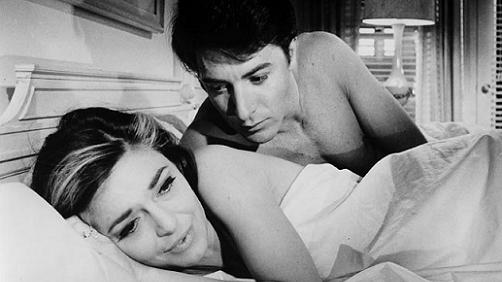
Watching The Graduate (Mike Nichols, 1967) is an experience that is uplifting and depressing at the same time. Uplifting because the film marries a stimulating aesthetic and a good story so effortlessly. It is a true crowd-pleaser, because it can be simply enjoyed as a comedy-drama or engaged with and understood in more complex ways if you choose: either approach works well. Watching such a film is depressing only because it reminds you how rare it is for a film to truly make you sit up and pay attention, let alone stand up and cheer.
The Graduate grabs the audience and draws them in from the very first moment. The film’s protagonist, Benjamin (Dustin Hoffman), acts as an anchor in the strongly composed opening shots, setting the tone for the rest of the film. While Benjamin stares straight ahead, lost in thought, his self-absorption is balanced and enhanced by the shots’ mobility, as the camera zooms away from him in the plane cabin, or tracks alongside him as he is passively carried forward on the airport’s moving walkway.
Some young people like to conceive of their own lives as a film, where their favourite songs become the soundtrack. In The Graduate the insistent, albeit extradiegetic, Simon and Garfunkel songs seem to serve a similar role for the self-obsessed Benjamin. An overachiever who has just completed his undergraduate studies, he is obsessed with anxiety: where does he go from here? Until now, he has simply followed an expected educational path, but does he really want to become like his parents and their friends?
Benjamin’s worries may seem petty, but they point to a broader unease with contemporary bourgeois America. True, Benjamin has little to worry about. He is young, an only child with devoted parents; he has a good education, drives a red sports car, and lives in a manicured neighbourhood in California, where houses have expansive lawns out front and swimming pools out back. But luxury seems like mere background noise in the face of Benjamin’s existential angst. As he returns home to be feted by his proud parents, who mercilessly put him on display like a pet or child prodigy, the film makes his new-found unease with this life palpable. At his welcome-home party, close-ups reflect Benjamin’s introversion and the oppressive atmosphere as his parents’ friends crowd around to congratulate him and enquire about his future plans. Later, to celebrate his 21st birthday, Benjamin’s parents force him to demonstrate his new diving equipment in their swimming pool. The camera gives Benjamin’s perspective on the party, the guests framed by the diving mask, and their inane chatter muffled by the rubber suit and the sound of the breathing apparatus. This stylistic technique conveys a powerful sense of Benjamin’s alienation from this society’s oppressively cheerful pretension and conformity.

The Graduate challenges superficiality in several important ways. The first is in the casting of its lead, Dustin Hoffman. In the book on which the film is based, the protagonist was a prototypical Californian: tall, blonde and athletic. The short, dark-haired Hoffman is quite the opposite. Although he is tanned, muscular and has a sympathetic face, he is not conventionally handsome. A tall, blonde actor would, I believe, have made for an entirely different, and far less compelling film. Hoffman’s appearance visually underscores his character’s feeling of difference from those around him. Also, his stature corresponds with his callow anxiety, as he shrinks away from situations that make him uncomfortable. This forms a powerful contrast with the calm self-assurance of his older lover, Mrs. Robinson. Although cast as a 21-year-old, Hoffman was in fact nearly 10 years older, and although he plays the part of an inexperienced youth very well, his maturity allows him to effectively adopt a more assertive role when he has to fight for the younger woman he wants to marry.
The Graduate does better than many more recent coming-of-age films in terms of its attitude to gender. Audiences might expect a more sensationalist approach to a story about a young man seduced by an older, married woman, but the film treats male and female characters equally: both men and women in the film have a capacity for hysteria, but are also given the same opportunity to reveal the raw humanity behind their genteel social façades. The film’s moments of melodrama are relatively rare, and this lends them greater power: when Mrs. Robinson warns Benjamin that she could reveal their affair to her daughter; when Mr. Robinson shrilly confronts his rival; when Elaine Robinson screams to drown out the true story of her mother’s affair. Mrs. Robinson is an alcoholic, but there are none of the bitter rants you might expect. Mrs. Robinson and her daughter each reveal their vulnerable sides to Benjamin, but only in brief (and therefore touching) flashes: there is also the sense that these revelations are there to lend the characters humanity rather than to lend the film drama.
The film is also unusual in that the female characters’ psychology seems as interesting, and potentially dark, as that of the male characters. The biggest question is why Mrs. Robinson forbids Benjamin to date her daughter. Is it because she wants to protect Elaine from the quasi-incestuous situation of sharing a man with her mother? Or is it a darker spirit of jealousy and pride that makes Mrs. Robinson unable to bear the thought of losing her lover to a younger version of herself? This raises the complementary question of why Benjamin ultimately becomes obsessed with the idea of marrying Elaine. Is he simply under the spell of Elaine’s gentle, youthful appeal? Or is it, perversely, because her mother has said she is off-limits, and because Elaine herself rejects him, lending the relationship an extreme thrill of the chase? Or has Bejamin’s first lover, Mrs. Robinson, made such an impression on him that he feels compelled, when choosing a wife closer to his own age, to find someone as similar as possible? When Mrs. Robinson tells Benjamin that he must never date Elaine, he demands to know why, egocentrically assuming that it is because he is not good enough for her. Although this reason is the least likely, it invites the audience to think about the many different reasons that motivate all of the characters’ behaviour.
Benjamin and Elaine run away together in what is one of the most memorable wedding scenes in film history: here, male and female characters are equally implicated in defending and rejecting the status quo. It is not certain that Elaine and Benjamin will succeed in escaping the disappointments and compromises of the life that they are leaving behind, but they have at least taken a stand against the superficiality of loveless marriages and a materialist lifestyle. This assertion is epitomised by the film’s final images of the happy couple, Elaine in a wedding dress and Benjamin in grubby civvies, sitting at the back of a bus, unfazed by the unfriendly stares of their elderly fellow passengers.


