
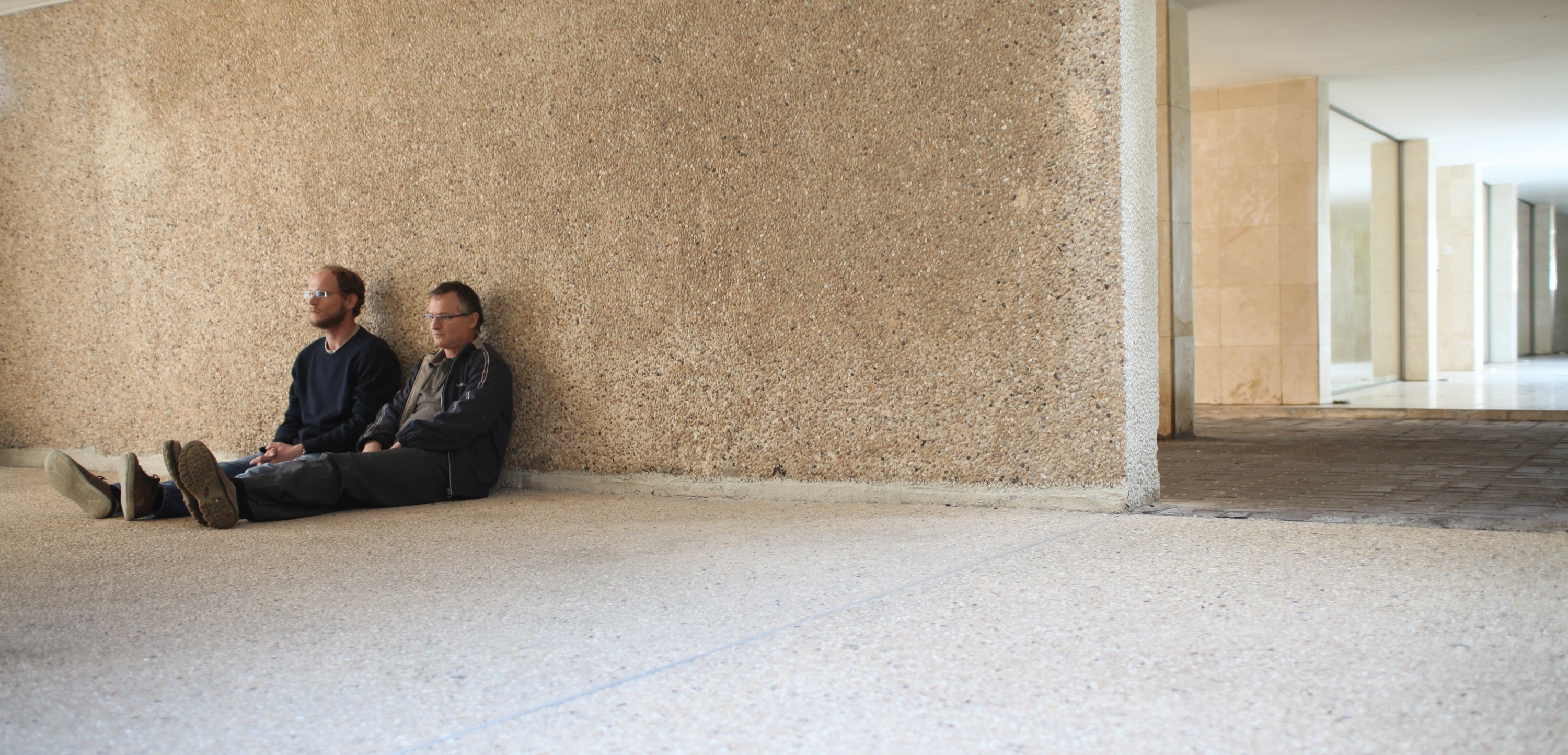
The Exchange (Hahithalfut, 2011) is the latest feature from Eran Kolirin, who made a crowd-pleasing debut with his 2007 comedy The Band’s Visit. His new film is also intended as a comedy, but contains very few laughs. It concerns Oded, a PhD student in physics, who lives in quiet contentment with his wife Tami, a recently-graduated architect looking for work. One day, Oded forgets a binder at home: he returns to his apartment, and is intrigued to see how different everything looks in the midday light. His fascination rapidly turns to obsession: from that day on, he finds any excuse to come home during the day and contemplate his flat, silently and alone, doing his best to avoid Tami. He finds a co-conspiritor in Yoav, an older neighbour who introduces him to new forms of eccentric behaviour.
Having a research interest in Surrealist cinema, I was intrigued by the London Film Festival’s programme description of The Exchange: Oded finds that his ‘familiar environment’ becomes ‘strange and alien’ and he is ‘increasingly fascinated by the world around him’. One of the Surrealists’ goals was to convince people of the hidden power in their everyday surroundings, but they found it challenging to communicate this subjective, psychological discovery through film. The Surrealists felt that the use of special effects would make the film feel too distanced from reality, but how else to effectively communicate a revolution in the way a character sees things? One way is through close-ups that reveal objects’ details and transform their everyday appearance. In The Exchange, the camera does explore space to a certain degree, reflecting Oded’s fixation on objects and surfaces, but not as extensively as it could. Typically, the camera is fixed at some distance from Oded, watching him as he gazes fixedly at his surroundings. This quickly becomes tiresome, as does the character of Oded himself.
To read the film’s description, you might expect potential problems to lie with boring shots of everyday surroundings, or a lack of narrative development. Visually, the film was not boring: in fact, its aesthetic was its strongest quality. Oded’s apartment, the streets around it, and the university campus were not chock full of interesting details, but there was just enough realistic clutter. The images were bathed in a soft, warm light that made them pleasing and restful to watch. There was also a decent narrative momentum, though it was an upsetting one, as it traced Oded’s destructive and pointless descent into self-absorbed contemplation.
It is debatable whether a person who came to this film without knowing its premise in advance would understand that Oded’s journey is supposed to be one of discovery. It is more likely that they would see him as a mad professor in training. Rather than presenting an inspirational image of a man rediscovering the wonder of his surroundings, The Exchange shows Oded as childishly fixated on the material world at the expense of those around him. He stares vacantly at his wife, students, colleagues, and strangers, which must be as alienating and disconcerting for them as it is irritating to the viewer. When Oded does seek out interaction, it is creepily orchestrated: Yoav instructs Oded to talk to his wife or father (who do not know Oded) while he secretly watches. In the film’s most unsettling scenes, Oded or Yoav sees a loved one in trouble, but continues to watch coldly, like a detached spectator, rather than intervening.
The director’s notes to the film said that The Exchange is not only a narrative about the quest to obtain a ‘stranger’s gaze’: it is also ‘a story about the end of a relationship’. The description seems disingenuous as a plot motivation, because there seems to be nothing fundamentally wrong with Oded and Tami’s relationship until Oded happens to develop a pointless obsession. At the beginning of the film, they are loving towards each other, support each other’s career goals, and have sex regularly—so much so, they are expecting their first child. To see a viable relationship destroyed by an unnecessary obsession is depressing, not comic.


