
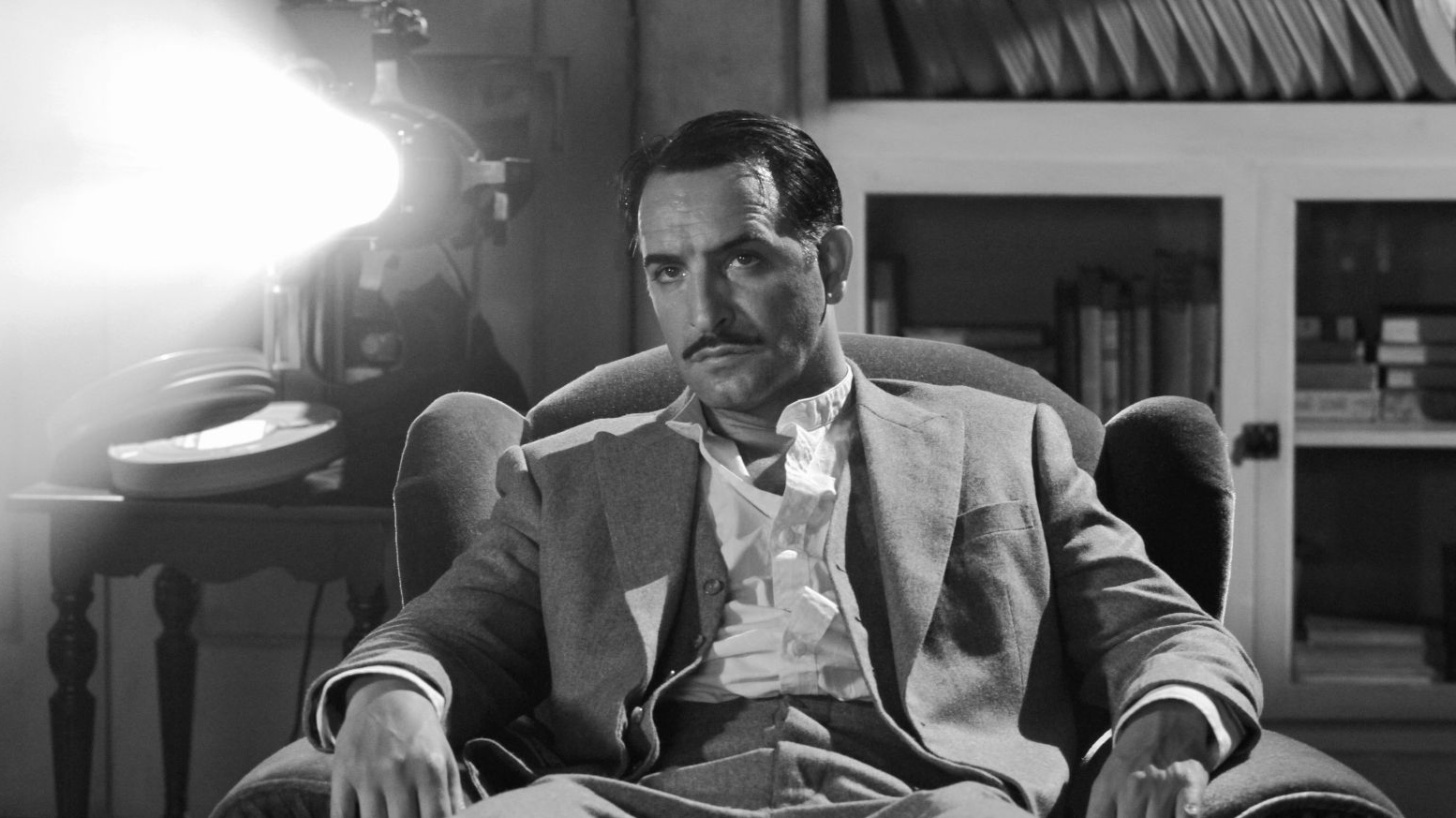
I’m getting a little tired of seeing Jean Dujardin’s face. That I can say this about an actor I like so much reflects the degree of media saturation surrounding The Artist. For most of January, the same shot of Dujardin stared out at me every time I opened the arts section of a newspaper or a copy of TimeOut. The Artist has become The King’s Speech of 2012. It’s hard to find a critic with a word to say against it: kudos to Francine Stock for bringing up the word pastiche in her interview with Michel Haznavicius, who nobly accepted it. The public are flocking to see the film, and seem to be enjoying it very much—apart from the people who demanded their money back when they discovered that the film was silent…
On the strength of Hazanavicius’ previous James Bond spoofs (OSS 117: Lost in Rio and OSS 117: Cairo Nest of Spies), I was very excited about The Artist. That excitement turned to disappointment on seeing the film, though. If you’ve watched Singing in the Rain, the subject matter is no surprise: when films went from silent to sonorised, it was a big shock for many actors, whose voices suddenly made them unsuited for their roles. In the case of George Valentin (Dujardin’s character in The Artist), there is nothing wrong with his voice: it is more a case of old talent and old technology being swept aside all at once. The film’s storyline follows a predictable, frankly boring arc: obviously Valentin is going to get the girl, and obviously he will find his footing in the industry once again. In a film that slavishly devotes itself to past conventions, is any other outcome possible?
For critics, The Artist offers a degree of nerdy enjoyment: they can simultaneously indulge in the pleasure of a freshly-made silent film, and spot references to original silent classics. For audiences who have never watched a silent movie in the cinema before, The Artist offers a high-quality introduction to a charming mode of film-making. But why not simply watch old silent films, if you have the opportunity? True, it is not always easy to find a cinema screening them. But does that mean we should fawn over films that merely re-hash old themes and set-pieces?
The Artist makes just two worthwhile contributions to cinema. The first is Jean Dujardin’s perfect impersonation a silent movie actor, as convincing as his 1960s secret agent in the OSS films. Even here, it is hard to say that The Artist is entirely new: Georges Valentin and Hubert Bonisseur de la Bath (OSS117) are really the same character: a man who presents a suave and charming surface, but soon shows himself to be utterly egocentric, and oblivious to anyone’s feelings but his own.
The Artist‘s biggest innovation comes in just one scene, about halfway through, where the silent film becomes temporarily sonorised. The 2012 audience is suddenly able to experience what it must have been like for audiences used to silent films to suddenly hear sound in a movie: it is shocking, intrusive even. If only The Artist had incorporated more moments like this, it could have been an inspiring and original take on silent movies.
Last year’s adoring coverage of The King’s Speech may be partly explained by a sense of national pride in UK critics: maybe it seemed perverse to attack a low-budget British film that was proving to be a huge box-office success at home and abroad. I suggested in a blog on the film that there was an inherent conservatism in The King’s Speech that corresponded to the general mood in a time of economic instability. In The Artist, we find another film that looks fondly backwards, concerning itself with the comparably irrelevant problems of an over-privileged man. The 2012 Oscar nominations reflect the degree to which contemporary cinema tastes are fixated on the past: The Artist, Hugo, Midnight in Paris, The Help, War Horse… Common wisdom says that we look to cinema for escapism in hard times, but films that dare to address contemporary concerns don’t have to be depressing. They can give us a new perspective, and inspire us by breaking fresh ground. What’s depressing are so-called new films that unquestioningly repeat the past.


