
The first three shots of Anton Corbijn’s The American are enchanting, and prepare the audience for a real treat. The film fades in on a stationary shot of a pristine snowy plain with a Norwegian forest in the background. There is not a single person present, and the audience doesn’t dare break the silence with a cough or a shuffle. The magical tranquillity continues, as this first shot is replaced by an image of a wood cabin, warm light spilling from its windows. The camera tracks silently in. The third shot is inside the cabin: an intimate close-up of George Clooney (looking almost unrecognisably rugged with his salt-and-pepper beard) and a beautiful companion relaxing in the nude. As the first sequence continues, a balance is achieved between art and action. The more reflective or aesthetic shots are not only skilfully composed but also perfectly paced, lasting just long enough to make their effect. In any case, the audience does not have a chance to get bored, as violence soon intervenes, and the scene concludes in an altogether unexpected way.
Unfortunately, the rest of the film does not deliver on the promise of the opening scene, and this is unusual. I generally find that I can tell a lot about a film from the very first shot. If that first shot is boring, typically the rest of the film also drags on (I had this initial sinking feeling when watching Pink Saris). An attention-grabbing first shot normally prepares you for a film that will engage your attention throughout (as was the case with Cold Fish). And an opening shot that is tranquil but well-timed most often means that the rest of the film will be carefully edited too (The Light Thief is a good example). The opening of The American put me in a very positive frame of mind, so it was with disappointment that I realised, about twenty minutes into the film, that it wasn’t living up to my initial expectations.
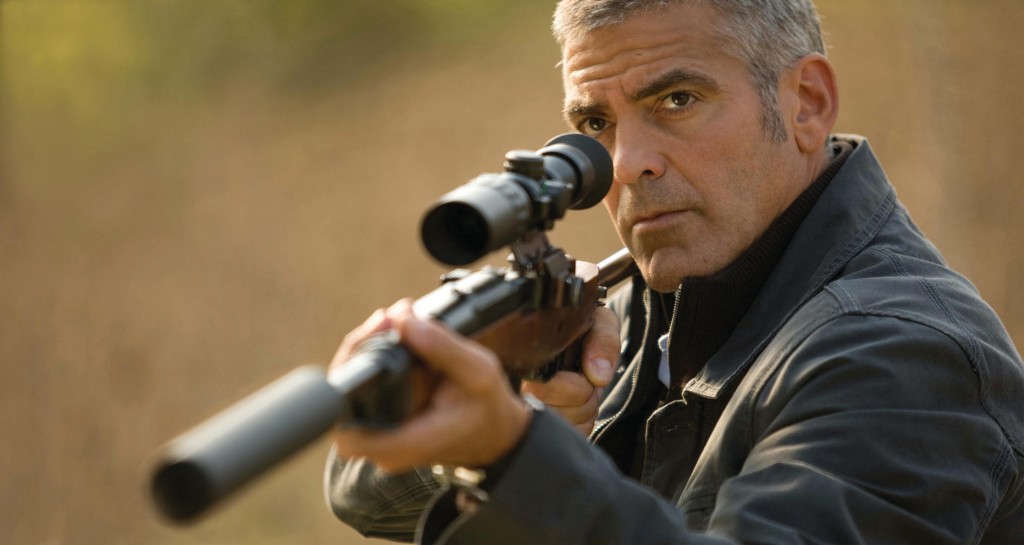
To be fair, the film does to some degree give the audience the pleasurable novelty of seeing a much-loved Hollywood actor appearing in a more contemplative, European-style film. Clooney’s character is Jack, a hit man who retreats to a mountain village in Italy to lie low for while, though it quickly becomes clear that his real intention is to escape his lonely and violent career altogether. The character Clooney plays and the goal that he has in mind are typical of the Hollywood films he normally appears in. However, the events that result are more characteristic of European art film. The American portrays what the life of a hit-man in hiding might plausibly be like in reality. There is some action, but not a lot: most of Jack’s time is spent obtaining the parts to make a specialised gun, and painstakingly putting them together. He forms an unlikely friendship with the local priest, and slowly develops an attachment for one of the girls who works at the village brothel. Although there are a couple of people who pose a genuine threat to him, most of the time Jack is simply on the alert for attackers who aren’t there.
Initially, the impression of observing real life is refreshing. Too many films set in Italy cater to popular romantic conceptions of the country: outstanding architecture, beautiful people, fantastic food. While these are obviously part of Italy’s reality, the romanticised view is one-dimensional as it completely excludes more modest aspects of everyday living. This film displays rugged landscapes and ancient villages which are pleasant but not stunningly beautiful. Scenes take place in old telephone booths, in boring squares, under fluorescent tubes in small apartments, and in grubby cafés where a good coffee is a standard part of daily life rather than something to get excited about. But it is not the point of this film to give a well-rounded picture of the real Italy: The American clearly sets itself out as a narrative with defined goals, and as such the drab background is no more than that: background. As for the action, perhaps the film is too realistic, as it takes some time for Jack to work towards his goals, and the audience is left simply watching him perform small tasks.
Admittedly, most audience members won’t mind watching George Clooney doing nothing at all. But this film manages to take the fondness that many viewers will feel for Clooney as an actor, and make it evaporate having him cast as a one-dimensional character. All we know about Jack is that he is a reluctant killer. The audience is given no further details about his past or his hopes for the future. It becomes clear that one of the reasons he would like to move on is that he is tired of the solitude his work demands, and that he might like a long-term relationship. But early in the film he shows that he is capable of seemingly gratuitous violence, and the rest of the film does very little to balance this out. The audience feels some natural sympathy for Jack as the protagonist of the film, but it is difficult to truly like him for anything more than his good looks and fine dress sense.
The film’s American-style character motivation and plot is spoiled, then, by poor characterisation and art-film paced action. On the other hand, what begins as a pleasingly subtle visual detail characteristic of art cinema is ultimately reduced to a laboured and simplistic symbol typical of the worst Hollywood movies. Jack has a tattoo of a butterfly between his shoulder blades which he displays during his daily body-building exercises. One night, Jack is lying in bed reading what appears to be a nature guide, and there is an understated echo of his tattoo in the diagrams of butterflies. Later, when he needs to meet a client in a secluded location to test a rifle, he chooses a riverside spot and takes a picnic as a cover. When a butterfly lands on his client’s arm and he tells her that it is endangered, she is intrigued by the implication that a calculating criminal has a secret love of nature. She then teases him with the name ‘Mr. Butterfly’. It is here, though, that the symbolism starts to go downhill. When Jack next displays his tattoo at the brothel, his favourite prostitute also starts calling him ‘Mr. Butterfly’. At the film’s supposedly tragic end, the camera pans up from the scene of the tragedy to silently follow a white butterfly fluttering up into the treetops. Although there some pleasing symmetry between the film’s opening and closing scenes, the butterfly symbol is overemphasised and so loses its interest. The picnic scene already made the symbolism of the butterfly quite clear enough: it pointed out that Jack’s interest in butterflies reflects a gentler side to his character. Calling him Mr. Butterfly was taking things too far, and the butterfly flying up into the treetops was pure cliché.
While the events and, in some respects, the style of the ending copy the opening of the film, in every other way the film’s final sequence is the exact opposite of the first. Where the opening shots were full of magic and promise, the final shots completely break any spell the film is still able to cast. If you thought that happy endings were contrived, this sad ending manages to be even worse. I don’t want to spoil it by describing it shot by shot, but I can say that it tries so hard to be tragic that it makes you want to laugh.


