
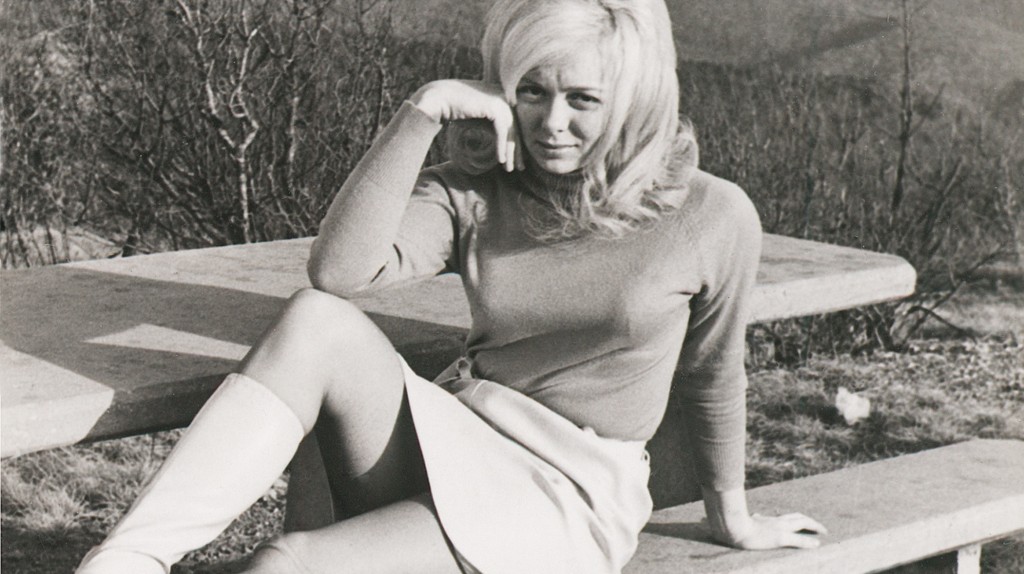
Tabloid is a documentary which uses interviews to investigate a case which was a source of lurid fascination to the British public in the late 1970s and early 1980s. Joyce McKinney was an American beauty queen who came to England in search of her fiancé, Kirk Anderson, who was a Mormon. She believed that his church had brainwashed him into leaving her, and she intended to rescue him. What actually happened when she located him is the subject of conflicting reports: McKinney said that they spent an idyllic weekend together, as she tried to help him to overcome the destructive sexual repression that the church had instilled in him. When Anderson returned to his church, he maintained that he had been kidnapped by McKinney, that she had chained him up and forced him to have sex with her. Based on his accusations, McKinney was arrested, and the tabloids leapt on the story: ‘the case of the manacled Mormon’. As one of the tabloid reporters said in an interview, it was a perfect tabloid story: ‘it had a beauty queen, a gun, love, sex, bondage, religion—something for everyone’.
Tabloid’s approach to documentary is typical of director Errol Morris insofar as it leaves the audience to come to their own conclusions, or to conclude that no definite answer is possible. The subjects of the documentary gaze directly into the camera, and each interview clip contributes a little more to the story, or a little more to its competing points of view. It is a style that is transparent, aside from the occasionally ironic illustration provided by archive photos or pop culture images: the documentary seems to construct itself in an organic way, so that you could almost forget that there is a director carefully controlling its flow. This is precisely where Errol Morris’s skill lies: to make the progression of the story and argument feel natural: the audience is able to follow it easily and with pleasure. There is no sense that they have been spoon-fed the director’s personal point of view. This lack of didacticism is another of Errol Morris’s skills: as he assumes a position of neutrality, the audience can enjoy being in the position of the investigator, weighing up all of the arguments that are made and trying to decide for themselves what the most likely answer is. In the of case Morris’s early masterpiece The Thin Blue Line (1988), the question was serious: ‘who killed the police officer?’ Tabloid is slightly more light-hearted, as there may not even have been a crime. Its question is, ‘did a kidnapping take place?’
There are other, more implicit questions that Tabloid asks, though. It leads the audience to examine their feelings and opinions about love at first sight, traditional lifestyles, gender, sex, religion, tabloid journalism and the borderline between sanity and psychological disturbance. All of these topics arise as the audience listens to the testimony of Joyce McKinney, a man she enlisted to help her, tabloid reporters and a lapsed Mormon (Kirk Anderson himself refused to be interviewed for the film, unfortunately, and McKinney’s main supporter recently died).
There is a lot of humour in this film: the audience laugh with the British tabloid journalists as they make wry observations about the case. They also have many opportunities to laugh at the earnest, provincial McKinney with her quaint turns of phrase and her mispronunciations. Interestingly, though, when McKinney began to express her genuine hurt and despair at everything that had happened in her life, and to explain how much the companionship of her pets has meant to her, nobody in the audience laughed. During the Q&A, concerned audience members wanted to know if McKinney had ever received any psychological assessment. Although the tabloid reporters come across as good-humoured cynics, some of their observations betray the tabloid reporter’s necessary indifference about the welfare of others. The Daily Express reporter recalled McKinney’s breakdown in his office, and subsequent fugue: although he describes it with ironic detachment, this may have been the precise moment at which the audience’s mood changed from amusement to concern.

Errol Morris invented the ‘Interrotron’, a camera which projects his face in the place of the lens: this allows his subjects simultaneously to look directly into the camera and at the director’s face as he asks them questions. A strong connection is therefore created between the audience and the interviewees: looking them directly in the eye makes it feel as though we are coming as close to the truth as possible. What Joyce McKinney says may not reflect objective reality, but she clearly believes in what she is saying. Is her obsession with Kirk Anderson an example of true, enduring love, or is it a symptom of delusion? Although some of McKinney’s actions are eccentric, and some of her ideas far-fetched, Kirk Anderson’s version of the story seems just as unlikely, and he had more reason to lie. As the lapsed Mormon perceptively remarked: the truth probably lies somewhere in between the two versions of events. The film leads the audience to acknowledge how many factors can influence an individual’s reliability as a witness: sometimes, there may be as many versions of the truth as there are different perspectives on a situation.


