
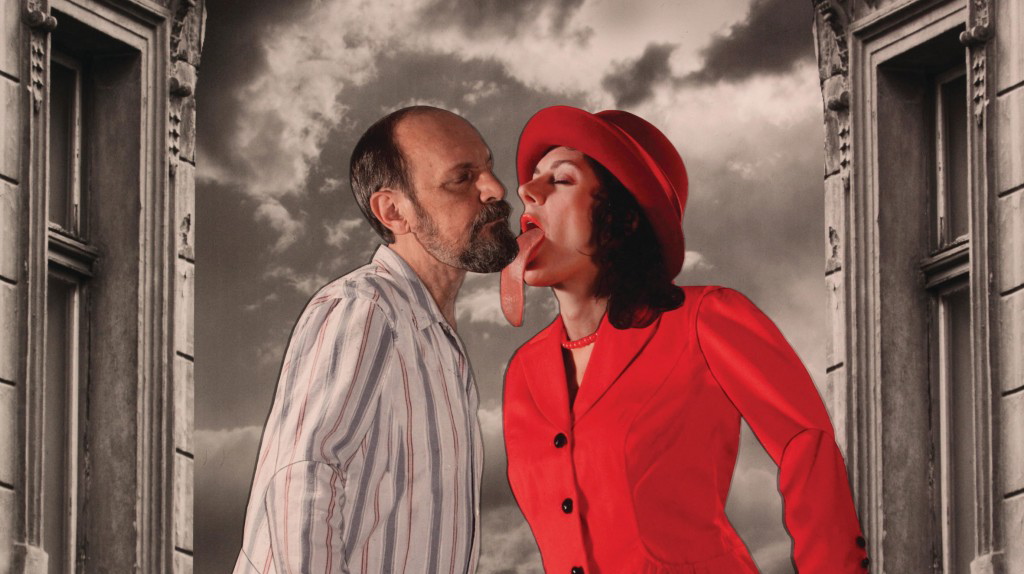
At the screening I attended of Jan Švankmajer’s Surviving Life (Theory and Practice) (2010), there were two walk-outs. I was tempted to follow, but my love of the great Czech animator’s previous work won out, making me want to experience, if not enjoy, every minute of his latest film.
Newcomers to Švankmajer would do best to start with his shorts from the 1960s and 80s, live-action Surrealist animations of everyday objects. Some people find them disturbing, but if you embrace their sheer creativity and magic, these films can take you right back to childhood, evoking its fear of the unknown, love of repetition, and sense that anything might happen.
If I hadn’t already seen two of Švankmajer’s feature-length films, having seen Surviving Life I would have said that the director should stick to short films. His tendency towards variations on a theme arguably works best in small doses, so the theme never has a chance to become tiresome. Alice (1988) and Little Otik (2000), despite being 86 and 132 minutes long respectively, work superbly, perhaps because both are based on children’s stories, and find the right balance between live action and stop-motion animation.
Surviving Life, in contrast, incorporates childhood themes, but is a decidedly adult story which, at 109 minutes, is boring in its repetition. It tells the story of a happily married man in late middle-age. One night, he happens to dream of a beautiful young woman, and subsequently becomes obsessed with dreaming in order to keep seeing her. The tune of a waltz associated with his dreams is repeated ad nauseum. The dreams don’t include enough variation to make them interesting, and the secret behind them is not much of a surprise.
The film’s biggest problem is its claustrophobic style, which combines with the repetition to make the audience feel trapped. Instead of using the live-action animation for which he is renowned, Švankmajer animates photographs of his actors, allowing for the easy introduction of Surrealist elements such as giant eggs, priapic teddy bears, and Ernst-inspired women with the heads of birds. This approach lacks the compelling originality that usually characterises Švankmajer’s films: instead, it seems a regurgitation of 1930s Surrealist collage and Monty Python’s Flying Circus animation. The live action elements are much shorter, and confined to close-ups and extreme close-ups of objects and characters’ faces.
Surviving Life begins with a message from Švankmajer himself, as an animated photo standing in the middle of a photo of a street that serves as one of his film sets. He explains that he animated photographs of his actors in order to save on production costs. This sounds like a reasonable explanation, but the director goes on to say that he is giving this introduction in order to draw the film out to an appropriate length. The introduction can be justified as meta-film, and it is a treat to see Švankmajer in his own film. However, even as a joke, the idea of throwing in an introduction to make the film longer seems like an insult to the audience, especially in light of the repetitive narrative that follows. The audience at the screening I attended clearly wanted to go along with the director, and made a few attempts at ironic or appreciative laughter throughout this pseudo-comedy, but it sounded weak and hollow.
Confirmed fans of Švankmajer’s work won’t want to miss this film: the work of a confirmed master is always of interest, even when it’s not his best. Surviving Life still features recognisable elements of the Švankmajer we know and love: giant tongues, huge appetites, and a general enthusiasm for the earthy side of life. Švankmajer also deserves praise for attempting to carry on the project that the French Surrealists abandoned after Un Chien andalou and L’Age d’or: that is, to use communicate Surrealism’s message via film.
Surviving Life demonstrates how dreams and reality overlap and does so in a straightforward manner, not by tying narrative knots so that the audience simply confuses real and imagined worlds (as in Woody Allen’s Deconstructing Harry, for instance). At the same time, while Švankmajer’s message is more meaningful than Woody Allen’s, the Surrealists would have disapproved of the fact that Surviving Life only demonstrates their point, rather than putting it in action: the audience remains an audience, simply observing how one man’s dreams relate to his waking life. As a result, the film becomes egocentric: the audience may have trouble relating to the character’s obsession with his own inner life. Ultimately, rather than showing that dream life is relevant to waking life, and is on the same plane, Surviving Life shows a man who becomes increasingly detached from his present life through dreams which are more relevant to his past.


