
 I recently had the pleasure of seeing a Polanski film in utter innocence. As the result of a rare set of circumstances, I found myself in the wrong cinema in front of a film which had a very restricted title sequence, so that I knew the title of the film from the beginning, but didn’t learn the director’s name until the end. I had of course heard that Polanski had a new film out, but not feeling particularly interested in the film’s political theme, I had forgotten about it. After the shock of realising that I was in the wrong cinema, I assumed that the film I was about to see was most likely a product of Hollywood: I was sitting in a multiplex with a relatively large audience, after all. The film’s European title, “The Ghost,” gives much less away than the American title, “The Ghost Writer,” although either could be the title of a Hollywood film. Faced with the opening images of cars leaving the hull of a ferry, while one car remains driverless and stationary, I wondered whether I was about to see a horror film, where the dull opening would lend the coming terror all the more impact. Was the driver of the car a ghost?
It is an unusual experience to find yourself watching a film that you know nothing about. Typically you have some idea of the film’s premise or at the very least its genre. Finding myself in the wrong cinema, and anticipating a banal Hollywood film, I did feel the impulse to walk out. Luckily, I decided to give the film a chance, and tried to enjoy the strange loss of control you feel when you have no idea what to expect. French surrealist André Breton used to seek out this feeling of disorientation by spending his Saturdays going from cinema to cinema, buying tickets for whatever film was playing, walking in at any point during the screening and heading off to another cinema as soon as he got bored. A less eccentric way of reproducing my experience would be to ask a friend to buy tickets to a film and surprise you, but in this case you will at least expect your friend to have chosen an interesting film. The true novelty of my experience was that I had no guarantee of the quality of the film that I was about to see, and so by default expected the worst. I watched it with none of the reverence with which you might normally approach a film by a celebrated director. I watched it with the critical attitude which ought to be adopted when faced with any film: rather than looking for excuses for the film’s failings, I scoffed at them. Ultimately, though, I was also intrigued by the film’s obvious strengths. This experience underlined for me in a very powerful way the difference between a low-budget Hollywood movie and a film by an auteur, albeit an auteur who is trying to appeal to popular tastes.
I was most critical during the first twenty minutes, before I had been drawn in by the engaging narrative. To summarise, “The Ghost” refers to a ghost writer (Ewan McGregor) who has been hired to edit the biography of a recently retired British prime minister, Adam Lang (Pierce Brosnan); the last ghost writer died under mysterious circumstances, but the main point of tension is that during the course of the editing, Lang is accused of complicity in torture, and this leads the ghost writer to look more closely at Lang’s past. The film’s early scenes take place in London, and they reflect the outsider’s clichéd (and in some respects inaccurate) image of the city — red double-decker buses and taxis feature prominently, Big Ben necessarily looms against a menacing sky and, if it is not actually raining, the ground is always wet from a recent downpour. To be fair, stereotyped images of famous cities are certainly not limited to Hollywood movies: I first fell out of love with Woody Allen’s films when he stopped setting them in the New York he knew so well, and instead cast a tourist’s gaze (albeit loving) on London and Barcelona. Some may argue that both Polanski and Allen use clichéd imagery in an ironic way: the delight of watching a film by an auteur without knowing it is that you come up with these excuses less readily, and are more likely to laugh or sigh at their lack of originality. I was also less tolerant of the predictable way in which The Ghost used music to manipulate the audience’s emotions, redundantly pointing to moments of tension. Similarly predictable was the way in which a potential romance between the Ghost and Lang’s wife was announced a mile off, and the Ghost’s discovery of an important document when he was moving into his new room — mundane activities in mainstream films invariably bring about key discoveries.
 I first began to suspect that I was watching something more than a run-of-the-mill Hollywood movie when I saw a minor character involved in a dull activity that had no influence on the plot. Gazing through the window, the Ghost watches a staff member sweeping the beachfront patio. A strong wind is blowing from the ocean, and it scatters the debris as soon as it has been gathered. The employee finally throws down his pan and brush in frustration. This short scene is characteristic of an art film in that it can be interpreted symbolically, setting the order of the house against the disorder of the outside world. The futile struggle of this minor character against forces he cannot control can be compared to Lang’s efforts to contain the torture scandal that may bring about his downfall. Lang is safe as long as he stays in the house, but as soon as he ventures outside, he will be met by reporters and protesters at the end of the driveway, and if he returns to the UK he risks immediate arrest. Even if these images of the employee’s impossible task are taken simply as comic relief, the approach to humour would nonetheless be unusual in a Hollywood film: the absurdity of the employee’s task creates a black humour which reflects Polanski’s Eastern European background. Also, humour in a Hollywood thriller is typically restricted to brief verbal exchanges between major characters, whereas here it is a purely physical humour, as in a silent film, and we don’t even know the name of the character involved. The other significant source of comedy in the film is similarly unexpected: where a Hollywood thriller would consider forbidden love to be an added layer of danger, in this film the relationship between the Ghost and Lang’s wife is largely farcical. She makes hilariously obvious advances, and he reacts with bewilderment—the speed at which their relationship develops is absurdly humorous.
As a political thriller, the film is a success. It was compelling, though not in the same way as the best Hollywood films in this genre. It invited comparison with real-life politics, reminding me of Paul Greengrass’s recent “Green Zone,” but Polanski’s film was much more subtle. Though exciting, “Green Zone’s” theme was almost didactic: it re-hashed the Iraq war, offering the director’s view of the truth behind the weapons of mass destruction debacle. “The Ghost,” on the other hand, began by alluding to reality before diving into a clearly fictional account: Adam Lang’s name may be syllabically identical to Tony Blair’s, and both fictional and real prime ministers did go to war alongside the US and had their integrity questioned thereafter. But Polanski is clearly not trying to suggest that Cherie Blair was a CIA agent and éminence grise. The other major difference between “Green Zone” and “The Ghost” is that Greengrass’s narrative moves along rapidly like the best Hollywood films, whereas Polanski’s is characteristic of the auteur film in that its rhythm is more nuanced. This can mean that the film becomes slow at times, but typically these dull moments are used as an opportunity for the tension to be turned up slowly, in the tradition of the best French psychological thrillers such as “Lemming” (Dominik Moll, 2005), “Caché” (Michael Haneke, 2005), and “Merci pour le chocolat” (Claude Chabrol, 2001). When The Ghost arrived at the beach house and began to navigate the clean minimalism of the house and the stark grandeur of the beaches and countryside surrounding it, I became alert for the first time in the film: if this was a Hollywood movie, it was unlike any other I had seen. Hollywood films do on occasion feature unusual pieces of architecture: the lake house in the Keanu Reeves film of the same name (Alejandro Agresti, 2006) is one example. But it is very rare in mainstream commercial cinema for buildings or landscape to participate in the narrative in the same way as in an auteur film: they are a mere backdrop which may help to create mood but they don’t substantially contribute to the film’s meaning in the way as setting regularly does in French films.
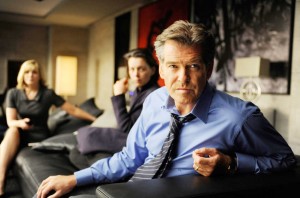 I would go so far as to say that this effect is not limited to the best French films: a sense of the impact of surroundings on those who inhabit them is evident even in otherwise unremarkable films. While in Paris, I saw quite a bad film called “UV” (Gilles Paquet-Brenner, 2007), which understandably never made it to cinemas outside France and Belgium. Virtually nothing took place in this film, apart from intense gazes exchanged by beautiful people: it was like a 90-minute perfume ad. Still, I have been unable to forget it. Its images of a cliffside house bathed in the dazzling sunlight of St. Tropez was like a series of modern landscape paintings, with clean lines and pure colours. Maybe the director attempted to be daring by allowing setting to take over from narrative until the very end: for most of the film the characters became part of this striking landscape rather than taking on any active role. Polanski’s approach to landscape in “The Ghost” was much easier to assimilate. The isolated house was impressive and the natural surroundings were striking, but they were not gratuitous: both had a believable place in the narrative, as the private hideaway of a former prime minister. Although this architecture and landscape could be interpreted symbolically, as I suggested earlier, their symbolic dimension was not over-emphasised: the significance of the setting pulsed in the background, providing a visual equivalent of the Langs’ secrets throbbing below the surface of the narrative. In this way “The Ghost,” while far from perfect, epitomises the best auteur films in that it manages both to tell an engaging story and to satisfy our search for meaning.
So, following a typically artistic ending which did not resolve things in the neat and happy Hollywood way, I was certainly surprised to see Polanski’s name appear on the screen. But I was only surprised that I had managed to watch the entire film without realising that it was his. Looking back on the film, there were more than enough clues to tell me that even when Polanski makes a popular film, he still does it like an artist.


