
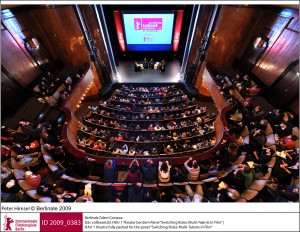
The Berlin Film Festival is not just about watching films that have already been made: it also invests in the future of cinema by nurturing new talent. The Berlinale Talent Campus, now in its 9th year, is a week-long series of events, taking place in parallel with the festival. It is intended to guide and inspire people at the beginning of their cinema careers: actors, directors, screenwriters, cinematographers, composers, producers and even journalists can apply. The 350 applicants who are selected to take part in the Talent Campus attend talks by industry professionals, and take part in workshops and hands-on studio sessions.
The Talent Campus model has proved successful, offering good networking opportunities: film careers and projects have started here, and the results have been screened at the Berlinale in subsequent years. The ‘Talent Project Market’ also gives some participants in the Talent Campus an opportunity to present their work to producers. The Talent Campus encourages applications from all over the world, and particularly those countries where the film infrastructure is weaker, and aspiring film professionals will benefit most from the opportunities that Talent Campus provides. The model has even been exported to Bosnia-Herzegovina, Mexico, South Africa and Argentina, where local Talent Campuses have been set up with the assistance of the Berlin Film Festival.
Although the Berlinale Talent Campus is selective, it is not an exclusive event. The lecture/panel-discussion component is open to the public and the press, so I decided to go along and experience this hotbed of inspiration for myself. Some of the topics of these lectures can be quite specialised (for example, how to deal with the legal issues surrounding film production), so not of much interest to the layman. ‘The Indie Filmmaker’s Guide to Cross-Media’ sounded like an excitingly avant-garde topic. Even if I never make a multi-platform creation myself, I optimistically anticipated a talk that would pique my imagination and enthusiasm by summarising the exciting new possibilities of expression that are being opened up by new technology.
The speakers at this event were Michel Reilhac (from Arte France Cinéma), Martin Ericsson (senior designer of ‘The Company P’, a Swedish Production Company) and Bruno Felix (co-founder of Dutch production studio Submarine). They said that new technology (specifically the Internet) is changing the way people consume media, and that to appeal to a younger audience, it is necessary to change our approach to storytelling: rather than making films and television programmes as we always have, and only then considering how different platforms can be used to distribute them, cross-media should be used as a creative principle, and kept in mind from the very inception of a project. This means incorporating a variety of different media into the storytelling process, using live-action film, animation, comics, mobile phones, internet and gaming.
The best speaker by far was Reilhac, who came up with his 10 Commandments (or ‘Transmendments’) for working with trans-media. He said that you have to collaborate (an activity filmmakers will be familiar with already); embrace (rather than despise) game culture; remember that people still enjoy the excitement of events (going to the cinema, concerts, etc). He said that when working with cross-media you have to be very careful about the distinction between reality and fiction: if you lead people to believe that something is real, there may be a backlash when it is discovered to be false. Finally (and reassuringly for the unconvinced), he said that you always begin with a story that is worth telling: even with all this new technology, a good story is still the essential foundation to your work.
The other two speakers’ contributions validated what Reilhac had said, as many of the same ideas cropped up. Unfortunately, Andersson and Felix each spent most of their allotted time talking about one of their own specific projects. Although these were concrete examples of what cross-media production can look like, they were too similar to each other: both Andersson’s and Felix’s projects were stories of international conspiracy. During the Q&A, some audience members wondered, quite rightly, whether cross-media tended to limit the types of stories which could be told, and were curious to know how successful these cross-media productions had actually been with audiences. After Reilhac’s talk about the theory of cross-media, it would have been much more helpful for the other two speakers to give a broader variety of examples of what you can actually do by working with multiple platforms. More examples would have fuelled the imagination of this audience of young film professionals: isn’t this the goal of the Talent Campus, rather than showcasing the work of the speakers?
Having listened to the three speakers, I was left with concerns and doubts, not excitement and inspiration. As part of the under-40 demographic that cross-media is intended to appeal to, my lack of enthusiasm can’t be blamed on generational differences. I was not convinced that cross-media has broad potential. As it was presented here, it seems to me that cross-media will either be used as a novelty, or will become a relatively limited new art form that will appeal to a niche audience. As a novelty, it will be a bit like 3D cinema: a few people will put the technology to use in a truly productive and thoughtful way, but most will just use it for its own sake, as an audience draw. This seems to encapsulate Felix’s approach: the ‘game’ elements he introduced to his cross-media project were rudimentary and dull. Andersson’s work incorporates different platforms in a more creative and dynamic way, but is an example of cross-media use that will appeal to a select group of people (specifically, those who enjoy role-playing—which struck me as a very masculine world, in most cases). Andersson believes that it is one of civilization’s great catastrophes that it is frowned upon for adults to pretend and engage in make-believe. He doesn’t seem to understand that only a certain type of person is happy to cast aside such inhibitions with a large group of strangers. Finally, as refreshingly democratic as it may sound to radically re-evaluate the role of the creator and return art to its ancient status as a group activity for everyone, what kind of art will this really produce, and what is its value beyond popular entertainment? I expect that a lot of people in the audience chose to work in film because they envisaged a particular role for themselves, rather than handing their role over to the public. How many budding film directors really want to become ‘event-organisers’ or ‘experience designers’?


