
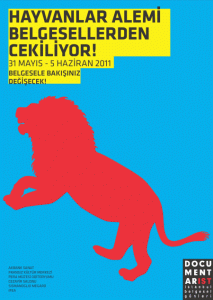
 Documentarist – Istanbul Documentary Days, Turkey’s largest documentary film festival, was held for the fourth time from May 31 to June 5, 2011. The festival has been garnering more attention internationally and widening the scope of its programme every year. The result of prodigious efforts undertaken by the founders as well as a large team of young people who are mainly university students, Documentarist is organized under the auspices of the Eurasia Art Collective (ASK) and is activist in its inclinations. This year’s festival was comprised of various sections focusing on such themes as environmentalism, music, anthropology and the post-communist era.
The World We Consume section of the festival included films with striking insights into some of the most important environmental issues of our times. “There Once Was an Island” (2010), directed by
Briar March, tells in a poignant manner the story of people of Takuu, a tiny low-lying atoll in the South Western Pacific. The population of the atoll, in their struggle to remain in their homeland and not be forced to start a completely new life in an unfamiliar land, are faced with the worst possible dilemma: as water levels rise and local vegetation has begun showing signs that it is surrendering to climate change, how long will it be possible for them to remain in their homeland and challenge the effects of a balance of nature which is in the process of being destroyed? The impressive photography in the film, which highlights the contrast between the paradisal beauty of the island and the transformation of nature, comes to the fore through the successful use of cinéma vérité techniques. The film keenly underscores the question posed by one of the inhabitants of the island: “Who do we call to help us?” and also addresses the problem of environmental refugees, an issue which is becoming increasingly important in terms of human rights law.
“Tankograd” (2009) by the Danish filmmaker Boris Bertram presents a well-narrated story about the modern dance scene in the radioactively polluted city of Chelyabinsk, masterfully weaving a dystopic vision of modern technology with a product of the modern in the art form of modern dance. The film piquantly conveys the sense that there is “no future” for the young generation in Chelyabinsk, based on the silent fact that they are living in a radioactively polluted city. Focusing on the daily and artistic life of a modern dance group, “Tankograd” depicts how this feeling is reflected through artistic expression. Comparisons regarding the appreciation and practice of stage arts in a pseudo-socialist, totalitarian Soviet mentality with that of today’s approach are reflected in the comments of the trainer of the dance group throughout the film; she notes that in the Soviet era, the dancer danced as part of the group, whereas, today he/she dances as an individual. With the use of superb electronic music and photography highlighting the mesmerizing choreography of the group’s dance shows, this fascinating documentary is also an elegant account of how great art can be inspired by unique experiences in remote corners of the world.
“Ecumenopolis: City Without Limits” (2011), by İmre Azem, evoked admiration when it was screened at the 30th International Istanbul Film Festival this year, taking as its subject one of the hottest and most controversial subjects in the agenda of the Istanbulites, the urban transformation project of the city. This well-made documentary turns viewers’ eyes to the distant corners of the city, where impoverished inhabitants are day by day being increasingly shunted aside, isolated and separated from the centre of the city through projects whose intents are dubious. These projects have been carried out in neighbourhoods of the city which are now being sold to building companies for astronomic prices. Through strong use of illustrations and computer animation, the film combines an aesthetic of computer gaming with impressive use of well-conducted interviews with the inhabitants of the areas in question, as well as with scholars and civil society activists who are engaged in resistance to transformations of the city which are unheedful of negative outcomes. This resistance is symbolized particularly by the campaign against the proposed project to construct a third bridge over the Bosphorus.
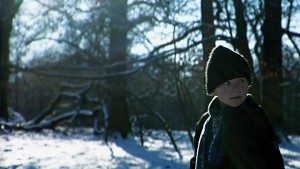
"Albert’s Winter” (2009) by Andreas Koefoed
Two Scandinavian films, “Albert’s Winter” (2009) by Andreas Koefoed from Denmark and “Poet of the Elephant House” (2010) by Anna Juhlin, came to the fore in The Human Landscapes: Portraits section of the festival. The former is based on the story of a child who has to make a critical decision about attending music school. As he watches his mother suffering from cancer, the film provides elaborate details which result in a lyrical aesthetic. The latter film tells the story of a Turkish poet and photographer who has been living in the same suburban apartment in Stockholm for more than 50 years, through the eyes of his granddaughter. Narrated by the director Juhlin, the granddaughter of the poet, the film elegantly traces the moments of an evolving bond between a grandfather and a grandchild through the common language of fascination with the arts and literature. Utilizing an approach which is fluid and stylistically refined, the documentary provides a portrait of a unique bond of affection.
This year’s festival had a special section dedicated to the Post-Communist Era. “The Desert of Forbidden Art” (2010), by Amanda Pope and Tchavdar Georgiev, was a highlight not only of this section but also of the whole festival. Based on the diaries and letters of Igor Savitsky and the artists whose works he rescued in his museum, as well as the recollections of the artists’ children and rare archival footage, the film is a gateway not only to the history of struggle for artistic freedom in the Stalinist era, but also to the great works of Russian avant-garde and to a school of Russian artists who settled in Uzbekistan in an attempt to escape state oppression and were remarkably inspired by the Islamic and Central Asian cultural legacy there.
The From the World section of the festival documented another struggle against oppression, in a different time and geography, again through the means of the arts; this time, through the artistic medium of theatre and by child Palestinian artists in “Arna’s Children” (2004). Juliano Mer-Khamis, who was assassinated in April 2011, and Danniel Danniel had shot footage of the work undertaken by Mer-Khamis’s mother, Arna Mer, with Palestinian children in an attempt to establish a children’s theatre group in Jenin in the 1980s. Seven years after the death of Arna Mer, and in the aftermath of the battle in Jenin in 2002, Mer-Khamis returns to the city and finds out that some of the members of his mother’s Nobel prize-winning theatre group have become suicide attackers. Constantly juxtaposing the clips of these people in their childhood with their new identities as suicide bombers, the film makes the audience ask: how does a child turn into a suicide bomber? The film presents these children sitting in the wrecks of their homes demolished by bombs, with nothing to cling to in the present and no hopes for the future, and in the process, the stories that we routinely read in newspapers and see in the news, suddenly strike us as real life experiences. Drawing the audience into its ambience of confusion and helplessness, “Arna’s Children,” through the voice of documentary film-making, is a call demanding that the ongoing tragedy in the area which victimizes both the people of Palestine and Israel, must be revealed.
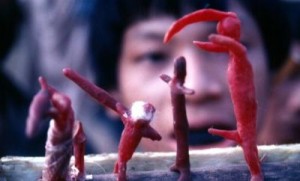
“Secrets of the Tribe” (2010) by Jose Padilha
The Anthropology and Documentary section of the festival gave the audience the opportunity to view “Secrets of the Tribe” (2010) by Jose Padilha, an intrepid voyage into the dark side of the discipline of anthropology. Every frame brings to mind the claim by French sociologist and anthropologist Pierre Bourdieu that reflexivity must be the ultimate instrument in sociological and anthropological research, and the film tells the history of how some Western scholars have performed a masked form of colonialism while researching a tribe in the Amazon in the 1970s. The film includes interviews made with anthropologists having opposing views on the controversy which focuses mainly on the research conducted by Napoleon Chagnon. This poignant and well-made documentary film, which deftly raises questions concerning the issue of the relationship between science and subject, deserves inclusion in the syllabi of all social sciences departments, particularly of those of anthropology and sociology.
The festival included some outstanding examples of contemporary documentary films from Turkey, as well. “Last Nomads in Anatolia ‘Sarikecililer’” (2010) by Yüksel Aksu, about the last representatives of the nomadic life style in Anatolia, emerged to the fore as a masterwork in terms of both narration and photography, accented as well as by an elaborate sense of humour. With Aksu’s keen eye for revealing the life philosophy of these last nomads, which is based on deep harmony with nature, this film is destined to become a classic in documentary film-making in Turkey on the themes of nature and life in the countryside, paving the way for more films in a country with so much to be explored on these issues.
“Urbanbugs” (2010) by Aykut Alp Ersoy, an accomplished, well-thought and well-crafted documentary about the graffiti sub-culture in Istanbul, was well-received at the festival for its multi-faceted approach to the subject matter. Another noteworthy Turkish documentary was “Offside” (2011) by Reyan Tuvi, which is about two young illegal African immigrants who are trying to become football players in Turkey. Interweaving their stories with the story of the murder of another African immigrant, Festus Okey, the film is very successful in reflecting the personal and psychological dimensions of immigration and the state of being in transit without falling prey to an approach that lapses into melodrama. The festival, just as in previous years, created a platform for discussions on documentary film-making: Helena Trestikova’s master class, the workshop with Asen Balıkçı, as well as talks and other side events all were inspirations for documentary film-making, especially among young cinephiles of Istanbul who are interested in the art of making documentary films. Visit the festival’s official website.
————————————
N. Buket Cengiz writes on popular culture for the national Turkish newspaper Radikal’s Sunday supplement, Radikal Iki, and works in Istanbul as a writing tutor at Kadir Has University’s Writing Center.


