
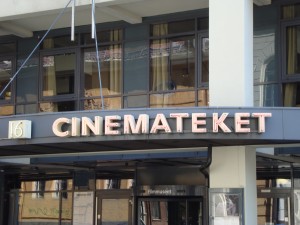
If you find yourself in Oslo, the Norwegian Film Institute’s ‘Filmmuseet’ (Film Museum) is worth a visit. Housed in ‘Filmens Hus’, same building as the city’s cinematheque, this free, compact exhibition gives an engaging overview of film history. It also highlights Norway’s own contributions to film, though in a way that caters more to nostalgic Norwegians than the uninitiated foreigner. Still, it’s educational to see how a nation thinks of itself cinematically. Film museums always give ample room to internationally famous figures: just as Berlin’s film museum devotes most space to Marlene Dietrich, so Oslo’s starts with a case full of Liv Ullman’s awards. Part of the joy of visiting any country, though, is to move beyond stereotypes, and learn how the locals really live: in terms of cinema, discovering the best-loved actors, directors and films that may be less renowned outside their home country.
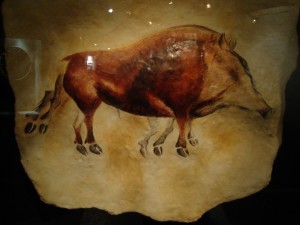
The Filmmuseet’s single-storey exhibition space is equally divided between general and Norwegian film history. The first, general section is one of the more concise yet informative that I’ve come across. It starts with cinema’s pre-history in magic lanterns and shadow puppets, looking as far back as cave paintings (clearly Werner Herzog was not the first to see the link).
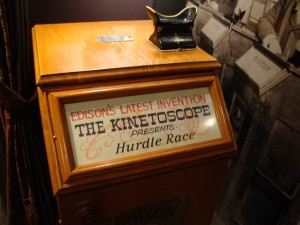
This section also showcases a number of early motion picture machines, and allows the visitor to try a few of them out. It has become fairly standard for film history exhibits to include a sample zoetrope to spin: many people have stared through the slits of such a device and experienced the illusion of a flying dove or a galloping horse. It is less common to have the opportunity to use a working kinetoscope: pressing a button while staring through a double viewfinder, the visitor can watch an early movie recorded on real celluloid. This was Edison’s invention for individual film viewing, and would ultimately be replaced by projectors that allowed whole rooms of people to watch movies together.
The second half of the museum focuses on Norwegian film history. There is a special exhibit on the country’s film censorship, from the early days of cinema when kisses and bare calves were controversial, to the 1970s when violence and drug abuse were of greater concern. Visitors can watch a loop of uncensored clips from the films in question, and peer through peepholes to examine individual frames that were excised.
Another highlight is a section on Norwegian animation. It begins with glass cases full of original 1950s figurines used by puppeteer and animator Ivo Caprino: wide-eyed dolls, gnarled trolls, and furry animals that were set in motion using a secret technique. The museum’s exhibit reveals the secret: the head and limbs of the figurine were attached with dozens of strings to a set of wooden keys, like a piano keyboard, which allowed Caprino precise control over the figurine’s movement. In his later work, Caprino used stop-motion animation instead. There are many clips of his work available on Youtube (doll phobics beware).
The museum also features more recent work from animator Pjotr Sapegin, one of the founders of Studio Magica, a Norwegian animation studio. His award-winning short ‘Huset pa kampen’ (‘One Day a Man Bought a House’, 1998), while different in style from Caprino’s work, shares its disconcerting unheimlich quality: it tells the tale of a man’s battle with a rat, which turns to romance. ‘Sniler’ (Snails, 2000) a witty, brightly-coloured claymation, is more appealing, in the manner of Aubier and Patar’s Panique au village (A Town Called Panic, 2009).The largest part of the Norwegian cinema section consists of film stills. Most charming is a tiny room where the visitor actually feels immersed in Norwegian cinema: three backlit walls are filled with small images, one frame from one film for each year of Norway’s film history. This is a good concept, but it is high time for them to update it, as there have been no additions since 1995. The corridor leading to the exit is devoted to Norwegian film stars, and although some had to move abroad to make names for themselves, they are nonetheless a proud part of Norway’s contribution to world cinema.


