
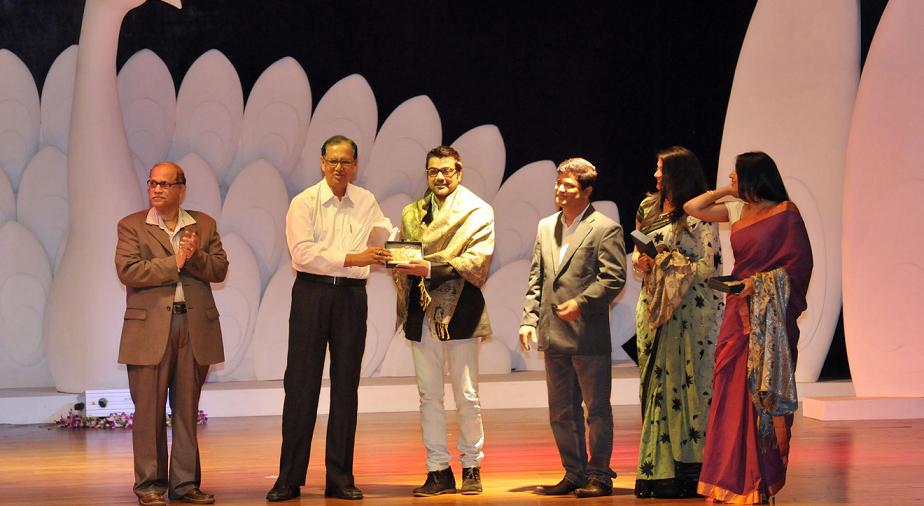
The Goa Film Festival that was from the 22nd of November to the 2nd of December and I managed to attend the first five days. Unfortunately, I got sick just after the festival and couldn’t compile the report in time. Anyway, some of the films screened here will go on to be important during award season and since that’s around the corner, I figured I’d club my impression of the festival with reviews of the films, since I had foreshadowed some of the buzz. Please keep in mind that this is not blow-by-blow and a laundry list of films reviewed but an impression of one of the biggest Asian film celebrations and the many conversations and predictions I managed to collect.
REWIND
So, here I am at the International Film Festival of India in Goa, an anarchic carnival of cinema that is as much an index of fine foreign film as it is an event of everything from sincere passion, shoulder-shrugging ennui, rabid brown-nosed networking and LOTS and LOTS of beer. Here are highlights of both the fare and the fair.
Day One
Today, I reached the theatre really early and still couldn’t get tickets! I missed this Australian crime drama with the fantastic Guy Pearce – “Animal Kingdom” – but I’d suggest keeping an eye out for its cast, which apparently was excellent and award-worthy. It was shitty, waiting around and getting pitying looks from the schmucks who’d managed to work the IFFI EBooking portal, which by the way does NOT work as it should. Met up with a friend finally and loafed about, soaking in the sun and the crowd. A high school friend was manning NFDC’s Film Bazaar stall and I heard Fatih Akin, Anurag Kashyap and Dibakar Banerjee are coming down. Sa-weet, must get the stalker kit read-ay!
Among the films that seems to have really pulled up a Barcalounger is the sequel to “East is East”, the very properly titled “West is West” popped my press-con cherry with its press conference and heard all about the autobiographical nature of the movie and its writer’s protectiveness of it. Things started getting political at one point, with the producer Leslee Udwin making a statement that simultaneously amused and offended me, saying that “Pakistani Punjab and Indian Punjab are essentially the same place.” Um…no? As it is, they are rounding up the trilogy, and continuing their success at christening, with “East is West”. What was interesting to hear was the story behind the production design and the sets, all of which were created and installed within admirably compressed periods of time, ranging from one week to a month, on location in the Punjab. It shall be released early next year in the UK, USA and India. Here is the press conference.
I just managed to watch one film – “The First Stone”, an Iranian comedy by Ebrahim Forouzesh. A light-hearted look at the meaning of life, the film failed to sustain its primary plot and ultimately faded away into wallpapery wanness. Blah.
As a rite of passage into the big, bad world of film journalism, I was determined to pipe up at a press conference and show off with a smart question. The opportunity came with the media meet for Jaideep Varma’s “Leaving Home”, a documentary about one of India’s most popular rock bands. The most commercially distributed documentary in Indian history, “Leaving Home” derives a great deal of its marketability from the untimely demise of Indian Ocean’s drummer, Asheem Chakravarty. Mr. Varma, quite the righteously angry, not-so-young man, minced no words about the state of independent Indian cinema and stated that the situation was worsening, despite feel-good media avowals to the contrary. He also explained how the title of the film is as much a reflection of the touring nature of rock bands in India, whose music is available chiefly through concerts rather than recorded media, as it is a summation of the idea of exiting one’s comfort zone to discover a greater world to thrive in. He has a very Gavin-Hood-at-the-Oscars vibe going for him, all stentorian auteur with cynicism to go with his fries.
Went home late.
Day Two
On my second day, I went for an 11 am screening of Alejandro Chomski’s Argentinian “Asleep In The Sun”. Meant to be an eerie ghost story, there was some interesting usage of vivid color schemes and very typically Latin American magic-realist mise en scene. The director was available afterwards for a Q & A but apart from a very repetitive discussion about magic realism, nothing insightful was offered. He did talk about how he went back and forth between the two poles of nature and supernature through the stylistic device of magic realism: “The story can start from the surface of reality and enter a world that is not real. Marquez, Borges, “Eternal Sunshine of the Spotless Mind” and even Tim Burton’s films are good examples of this.” Personally, I am not sure the director knew what he was trying to say while adapting his film from Casares’ novel, although he said he’d thought about it for fifteen years. An older film critic, who I befriended at this Q & A, reminded me that Dominik Moll’s “Lemmings” was a far superior depiction of the same idea.
Went for “Gei Oni” in the evening and met Dan Wolman, the director, for a brief word about the political burdens of being an Israeli filmmaker. The film is playing in competition. Speaking of which, there was a HUGE line for the premiere of Rituparno Ghosh’s “Nauka Doobi”. It’s based on a story by Nobel Laureate Rabindranath Tagore and will release in India on the 28th of January 2011. Ran into an acquaintance from the Film and Television Institute of India who saw it said that it received a standing ovation and continued Ghosh’s handling of delicate romantic dramas but that the effort was very forced and complacent, with this last one. Will wait till it is released to pass judgement. As with the other Indian film getting massive attention as a competitive entry, Umesh Kulkarni’s “Vihir” (a collegemate acted in it).
There is a retrospective of Jan Jakob Kolski and Eric Rohmer’s films being shown. Have already seen some Rohmer, so will skip “La Nuit Chez Maud” but might go for Kolski. A friend saw his “Pornography” in the morning and was impressed with it enough to urge me to check out some of his other films. He might hold a press conference before the week is out. There is also a retrospective of Michael Cacoyannis and it’s been forever since I saw “Zorba the Greek”, so I slipped in for a night show. Tatiana Papamoskou, his “Iphigenia”, opened the retrospective and it was nice to see an actor pay earnest homage to a filmmaker, in real time. The film is hardly great but I was surprised to find myself truly moved by some scenes, despite their obviousness.
Day Three
Lot of conversations and tidbits about various films. Extremely, extremely packed day. South Asia seems to be really bringing it, not least because the IFFI has a country focus on Taiwan. I heard a lot of great things about the first day screening of this Taiwanese film, Wang Yu-lin and Essay Liu’s “Seven Days in Heaven”, which might just have a little bit of that offbeat exotica element going in its favour when awards season comes around; it tries to head off in a direction not expected from a South Asian film. There are some films from Malaysia, Thailand and Singapore as well that are attracting attention simply because of their unusual provenance. I ended up watching something similar to “Seven Days in Heaven”, later that night, a very banal and uninspired Singaporean supposed ‘comedy’ called “The Blue Mansion” about a family dealing with the death of their patriarch (I walked out). The Thais have their Palm D’Or winning “Uncle Boonmee Who Can Recall His Past Lives” but I probably won’t get to see it because it’s playing next week. There is also Takeshi Kitano’s “Outrage” from Cannes, that played yesterday and seems to have a lotta tongues busy today at the beer kiosks, with his vivid and electric return to tales of yakuzas.
I saw a supremely disappointing film from Panama, “Chance” by Abner Benaim, a black comedy based on class wars between maids and masters in Central American society. What a mess. There were some expectations from Gangor, an Indo-Italian production directed by Italo Spinelli and based on a short story by Mahasweta Devi but the response after the film was lukewarm and I really doubt this is going to be a “Peepli Live”. “Moner Manush”, a Bengali film in competition, was already being tipped as good enough to win. It’s being released in December. A friend who saw it told me it wasn’t all that but you never know with the jury. I stood in line with two friends for “Rabbit Proof Fence” but after fifteen minutes had already ticked by in the queue I figured there was no point waiting.
Butbutbut…I flirted with Fatih Akin (I don’t think he got it though). Yes, it’s true. Homeboy came down for an NFDC sponsored screening of his latest, “Soul Kitchen” and surprised everyone. Well, a little. We kinda knew he was taking a holyfuck expensive masterclass over at the Marriott, as part of the deal, but well. The film was…er…not as consummate as the rest of his work but hell, who cares when you’ve got eyelashes that long (totally wasted on a man). I’ve always had this slight thing for him and he’s actually quite nice and laidback and much shorter than you’d expect up close. After the screening, a lot of people pounced on him in a scrum, for autographs. Anurag Kashyap, ostensible golden boy of co-dependent cinema in India, was chaperoning him and acting like a sidekick cop in a crime procedural. It has to be said. I like the guy but did he really have to grimace so badly when I tried to ask Akin my question? To be fair, people asked the most fantastically idiotic questions. These people were all male so I had the added advantage of standing out. I asked him how, in a comic film like this one, he dealt with his regular themes of in-betweenness and transience and how he defined that hesitation of belonging. I think I was speaking supersonically though because he said, “Darleeng, you have to slow down a leetle beet. I can’t understand you.” I repeated, resolutely defying Anurag Kashyap’s glare and then he answered:
“To me, the idea of home is very important. You know, as an immigrant, the Western media is always telling me that even though I am physically in Berlin, my head and my heart belong in Istanbul. But I don’t really believe that, I think home is what you create by yourself. Like the characters in ‘Soul Kitchen’, who are so lost in the beginning and belong to the restaurant by the end of the movie. You know, my dad used to say, “Home is where you bring the bread.” And in the film, they brought the bread into ‘Soul Kitchen.'”
No way I could’ve made that up, so you know I’m not lying.
Day Four
I have an Oscar contender on my hands – Susanne Bier’s “In A Better World”. It is an elegant and robust essay on violence and pacifism, childhood and adulthood, solitude and company, friendship and enmity and I would be surprised if it did not go on to contend for top honors during Hollywood’s award season. The other film I saw today is also in competition – Hsiao Ya-Chuan’s “Taipei Exchanges” but it tries too hard to show or say very little. A film that sparked a lot of eco-warrior exchanges over beer (the cheapest beverage around, in our collective defense) was this Canadian documentary called “The Man Who Saved The Taj Mahal” by Jay Bajaj. This documentary probably won’t reach dizzying heights of artistic success but will occupy an interesting place in discussions about attitudes to heritage and ecology.
Day Five
A few nice things: a Turkish delight (couldn’t resist) called “Brought By The Sea” directed by Nesli Colgecen, Jan Jakob Kolski press conference and a lovely little Tatar film called “Bibinur Story” by Yuri Feting, which is in competition.
“Brought By The Sea” didn’t win me over so much with originality of intent (it’s a mash-up of “Babel” and Camus’ “The Stranger”) as with the way it intended. It was a big hit in Turkey and one really has to watch the film to see why it would appeal so much to societies still trying to learn each other’s languages. “Bibinur Story” was a very sweet, fairytale-like visual salve set in the remote Tatar community of Russia, with a beguiling use of narrative and subtle but interesting subversions of cinematic norms.
Kolski conference (Kolskon?) would have been funner if I had managed to see any of his films. But the friend who liked him had, thankfully, filled me in enough to attend the presser without too much confusion. We needed a translator because he could speak only Polish so that took a bit of time to arrange.
He spoke about soooo much: how he was surprised that wherever his films went, audiences would relate them to their own situation, how magical realism was a sensitivity that explored “the invisible parts” of a spectrum of viewing things, how he was inspired by the very air which people breathed and proposed an ‘osmotic experience’ of culture, how pagans in Poland resisted Christianity so much that, like the tassels of a tablecloth, it persists in even the most staunchly (but “very shallow and decorative”) Catholic spaces of the Polish spirit, how Nazism and oppression simultaneously provide material for – in his case, “the deficit of love” from a father traumatized by the experience – and also excuses to not make good cinema and how, despite that, oppression is almost a necessary condition of good art – when the producer of ‘Pornography’ promised him every comfort, he “begged him not to!”. There was also a mention of Indo-Polish cooperation for filmmaking and funding by the Polish ambassador.
And with that, my reportage of the IFFI ends. With the run-up to awards season in full-swing, I shall review the films I saw and the ones that get more serious consideration. The best part about a film festival like this one is not always the films but also the crowd. The selection was rather pale, in all honesty, with very few new films that had sustained or even had had the potential to sustain themselves throughout the year. But the debates and discussions with other film lovers, the sneaking in without tickets as I screen-hopped and the beer made it all worthwhile.


