
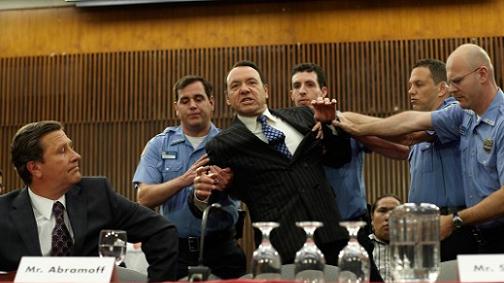
“Washington is like Hollywood, only without the pretty faces.” This, according to Kevin Spacey’s idealistic, wise-cracking super-lobbyist Jack Abramoff on the two-faced, backstabbing nature of capitol hill.
In 2006, Abramoff, who, by many accounts, was one of the most powerful men in Washington, pled guilty to defrauding four American Indian tribes of tens of millions of dollars, and to illegal dealings with SunCruz Casinos. His indictment led to a widespread corruption investigation that resulted in the convictions of top White House officials, U.S. Representative Bob Ney, and nine other lobbyists and Congressional aides, shaking the right-wing establishment to its core. And George Hickenlooper’s “Casino Jack” aims to tell the tale.
Spacey charges into the role full force, attacking the essence and nuances of his character with all the voracity and gusto with which Abramoff himself laid waste to the idea of ethics in politics. After twice winning Hollywood’s most coveted acting award, Spacey stepped out of the public eye in order to run the storied Old Vic theatre in London. It took Abramoff’s charmingly duplicitous personality to lure the Oscar-winner back to the big screen. Spacey’s performance is one of his best, and he’ll probably get some awards attention at the end of the year, but the film around him isn’t strong enough to put him over the top for his third Oscar.
Hickenlooper’s direction is uneven, leading to tonal inconsistencies in a film that clanks more than sings. There is however, one service “Casino Jack” provides that makes it a must-see. In grade school, American children learn that Thanksgiving is a special day commemorating a bountiful harvest and the peaceful relationship that developed between European settlers and Native Americans in the New World. Conveniently omitted are the details, like the genocide and enslavement of the latter that made is possible for us to celebrate the holiday in our big comfy houses that sit on their land. Likewise, many young school children are shown School House Rock’s “I’m Just a Bill,” a catchy, informative cartoon outlining the fascinating process by which a bill becomes a law in American government. The real value in “Casino Jack” is that it exposes the real Thanksgiving story behind this process. Our political system is fundamentally corrupt. Legislation is often nothing more than a bargaining chip. The wealthy have more freedoms than the poor, and aim to keep it that way. Special interest groups dictate the Congressional agenda. And so on. In that context, maybe we should be thanking Abramoff for inadvertently exposing the illegitimacy of our legislative system.
Beyond that, “Casino Jack” offers little that a careful reading of Abramoff’s Wikipedia page couldn’t. And if you followed the case closely as it unfolded in the news, there’s not much here that you didn’t know already. There are certainly worse ways to spend an evening at the movies. Then again, there are also a lot better. Try Alex Gibney’s thrilling documentary, “Casino Jack and the United States of Money” for a far more engaging take on the same material.


