
When I arrived at my hotel in Berlin to cover this festival, I was surprised to discover a default image of a fireplace quietly crackling away on the flat screen TV on the wall of my room. I wondered what our caveman relatives would have made of a civilization that has come to this point: we don’t need a fire for heat anymore, but we still enjoy seeing and hearing one, even if it’s virtual.
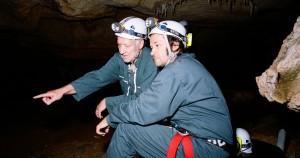
It was with a similar mindset that Werner Herzog seemed to approach his latest documentary project, Cave of Forgotten Dreams (2010). The director had the honour of being selected to film the Chauvet cave paintings in Ardèche, southern France. Discovered in 1994, these turned out to be the oldest cave paintings in the world: at 32,000 years old, they are more than twice the age of any cave paintings previously known. Until now, only a handful of experts had been allowed inside the cave to analyse the paintings: they are amazingly well preserved, but if too many people enter the caves, the delicate conditions there could be disturbed. The French government decided that people still ought to be able to see the paintings, so it was decided that they should be captured on films.
In some ways, Herzog was a curious choice of director to take on such a weighty responsibility. His last feature documentary, Encounters at the End of the World (2007), offered a look at Antarctica that was informative but also irreverent, wayward even. It was a refreshing and effective approach, however, and not just because it provided some unexpected humour in the documentary (such as the image of a penguin heading off alone, accompanied by Herzog wondering aloud whether madness exists among these animals). More importantly, even when Herzog seems to be going off on a wilful tangent, it is a path that often leads to a flash of insight, or at the very least an engaging line of thought. This happens in Cave of Forgotten Dreams, too: the most intriguing tangent begins when Herzog imagines what it was like for early humans to paint by firelight in the darkest parts of the cave. He describes how their shadows would have moved against the wall of the cave, mingling with the painted images of animals, themselves quite dynamic. Herzog cuts from the caves to a clip of Fred Astaire dancing with his shadow, and comments on this relationship as being a very ancient one. If a director can offer his audiences just one thought-provoking idea, I mean an idea that people will feel excited to think further about, he is already doing something extraordinary. Maybe it is to Herzog’s credit that he doesn’t wear out these ideas before you have a chance to think about them on your own—but I still feel like I would have enjoyed seeing him pursue some of these ideas a little further.
The main problem with Cave of Forgotten Dreams is that it doesn’t quite come together. It feels fragmented, with too many tangents that don’t lead to interesting insights. The worst example is a banal contribution from a perfumer who attempts to comment on the olifactory dimension of the caves. The ending to the film is also so tangential as to be irrelevant: in an epilogue, Herzog notes that there is a nuclear facility not far from the caves, and that the warm runoff water supplies a tropical greenhouse that houses a flourishing population of crocodiles. Herzog imagines these creatures finding their way underground to the Chauvet caves, and offers some philosophical musings on what they would think of it, and what their relationship with the paintings might be. Here, Herzog really fails to connect the dots: at the press screening I attended, the audience’s laughter suggested that this closing foray was philosophically closer to the absurd than the sublime. Then again, it is clear that some elements of Herzog’s style are intended to be comic rather than philosophical: most notably, his tendency to dwell on his interviewees’ faces a bit longer than necessary, especially after they themselves have talked just a bit too long, revealing the unexpected depth of their eccentricity.
This film feels like it was completed in a hurry, and so its effect is slightly uneven. It is worth seeing, though, for two reasons. First of all, the paintings themselves: putting the director and his aesthetic approach entirely aside, this film as a documentary offers everyone an extraordinary opportunity to see some of the oldest artwork humans have ever produced. If the term ‘cave paintings’ brings to mind faded, rudimentary stick figures, be prepared to have your mind blown. The Chauvet cave paintings look as though they were painted yesterday by a skilled artist: they are clearly delineated images of horses, lions, rhinos and other animals, many of them complete with details and shading. The second reason for seeing this film is that it is 3D—but with a difference. Most live-action films that use 3D put the technology first: either the entire film is created with 3D in mind, or else a film that could work well without this technology is disrupted by scenes designed to showcase 3D effects for their own sake. in Cave of Forgotten Dreams, we at last have a film where 3D is a rational choice motivated not by novelty value but by a necessity of the subject matter: Herzog has chosen to use 3D because it offers the audience a more life-like experience of a cave that they will probably never get a chance to see in person. Be sure to check it out—it is an astonishing sight.


