
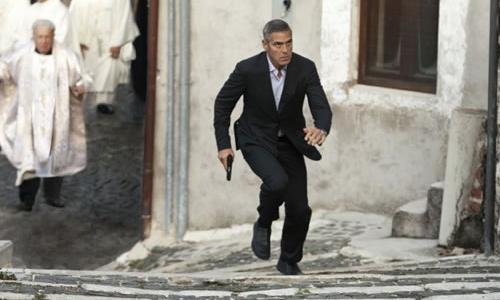
Well well well, finally a George Clooney film without “George Clooney.” Indeed, “The American” is a film without much claim to plot, action or dialogue and is yet a compelling watch. I was seduced by its atmospherics and ambition. Anton Corbijn not only has a cool name but has also directed the luminous love letter to Ian Curtis and ’80s rock-n-roll decadence, “Control” (2007), so I was expecting great things from “The American,” its poster mustering a late Hitchcockian retro-chic even as the movie itself suggests sophisticated European noir at its simmering smoothest. I was not disappointed.
There is a tang of “Leon” about the story but with an infinitely more nocturnal zest. George Clooney’s assassin protagonist, Jack, is a character study of the modern tragic hero, anguished by his choices and doomed by his ethical autonomy. I assume he is the American simply because there is nothing else at all distinctive about him — he can only be tagged by his accent and the origin it betrays. The film’s repeated use of a butterfly is a sideways glance at its chief conceit — freedom and its cost. The muslin-winged insect, an ironic counterpoise for a bloody murderer, perfectly symbolises the desolate life of a man without any discernible past or identity, forever fluttering his gauzy morals in a bid to propel himself forward somehow. His existential unrest and spiritual fatigue, unfurled with reverent gravity in tart interactions with a priest and nervous attempts at love, tussle with the reality of his life as a killer and as the story unfolds, the futility of his experience is divulged. Human liberty is denounced as a myth, our moral agency a necessary lie on which the individual arranges his or her existence, and Jack’s slow-boil confrontation with this truth, against a backdrop of self-deceit, paranoiac guilt and agnostic impertinence, a haunting account of a man trying to free his soul from the weight of his decisions.
“The American” was not meant to be an action thriller designed to labour through a three-act Hollywood structure and deliver an Aesopian edict; its meandering, disconnected amble sustains the deceptive humdrum of Jack’s ominous oppression. Its point was to depict the despair of a conflicted and lonely man with muted refinement, rather than melodramatic exposition. One might say that the film suffers from lack of exposition, a cinematic crime so much rarer than its opposite that one blinks a bit before even acknowledging it, but how much of the integrity of the film’s filigree would be compromised by letting on any more? Part of our engagement with Jack lies in the melancholic mystery of who he is and our ability to then inhabit his immediate crisis from the viewpoint of strangers rather than intimates. This is a character we must not care about, else the crucial question of what it is to be free will be sacrificed at the altar of familiar and excessive empathy.
The sparse narrative is a perfect vehicle for this subterranean trauma defining its protagonist and, indeed, professing a universal summation of man and woman’s tormented relationship with themselves. Wide frames and a ’70s-ish faux-aged palette lend an air of vintage spy movie (“The Parallax View” et al) and the hemmed-in tightness is brought out with some well-considered camera angles. The stylishness of Corbijn’s work cannot be doubted – the bright hues of the remote Italian village where our Mr. Butterfly cocoons himself, are drawn out intensely and the design of “The American” has an artisanal virtuosity that almost eats up the gaps in exposition.
The surprise was in seeing George Clooney play a character so unlike any that he has portrayed before, sullen and silent yet still kinda cool. A Steve McQueen without the charm if I may (and for Mr. Clooney, that’s saying something). His imperceptibly terrified Jack, going through the motions of life and making perfunctory attempts to salvage it even as he is vaguely aware of something gone awry, is a competent lead who summons enough solemnity to balance the delicately wrought porcelain narrative on his impressive-for-50 shoulders. Having said that, who knows what a Viggo Mortensen or a Clive Owen might have done with the role. The rest of the cast is almost one single cameo. Thekla Reuten’s enigmatic professional, Mathilde, brings a formidable force for Jack to play off his frustrations against and Violante Placido’s Clara offsets his darkness with an angelic sincerity that does ultimately become the viewer’s sole point of entry into Jack’s wretched heart and allow them a moment of sympathy for him.
“The American” is an elegiac meditation on the perils of free will, its nihilistic indifference to penance and the misery of self-imposed solitude. In the end, we are alone in our retribution and are invariably responsible for what we choose to do; we cannot escape destinies of our own logical selection. Corbijn’s austere rendition of a great modern dilemma occasionally tests one’s patience but offers at least some succour for the thinking viewer.


