
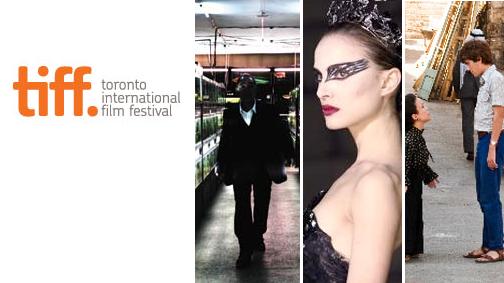
The selection of films at this year’s Toronto International Film Festival was even stronger than usual. Of the 10 films I saw, only one was frankly awful, three disappointing, while the rest were good or outstanding. Here is my overview of the must-sees and the must-avoids. Let’s start on a positive note:
1.) Cold Fish
Based on a true story, this film is focused on a serial killer who owns a tropical fish store. Although perhaps not for the squeamish, Cold Fish is more thriller than horror film. Above all, though, it is a study of character: the director argues that a normal person can be turned into a brutal murderer, given the wrong circumstances. To balance this sombre theme, the film features an unexpectedly large degree of black comedy: the audience was laughing for much of the film, albeit uneasily at times.
2.) Black Swan
Natalie Portman plays Nina, a dancer who is offered the roles of both black and white swans in Swan Lake. As the virginal ballerina struggles to get in touch with her darker impulses, she becomes increasingly paranoid and begins to suffer from terrifying visions. Surprisingly, it was Black Swan, rather than Cold Fish, that turned out to be the horror film. The Red Shoes meets The Sixth Sense, perhaps—but really, Aronofsky’s style is all his own. Kudos to him for using classical Hollywood format to create something entirely new.
3.) The Housemaid
A young woman starts a job as a maid for a wealthy family, and has an affair with the man of the house. The consequences of this affair turn the film into a stylish sort of thriller, ‘stylish’ because an equal part of the pleasure derives from the film’s aesthetic. While the house and its rich inhabitants are so formal that they seem slightly unreal, the servants share the audience’s normal reactions to this bizarre world: amusement, confusion, and sometimes disgust.
4.) The Matchmaker
In summer of 1968 in Haifa, a teenage boy takes a summer job working for the local matchmaker, Yoram Bride. Like Cold Fish, this film offers a generous dose of comedy to balance its serious message: this time, it concerns discrimination experienced by Holocaust survivors in Israel. Although The Matchmaker does not hold as many surprises as Avi Nesher’s last film, The Secrets (2007), like the earlier film it gives access to a world that will be unfamiliar to many viewers. A definite crowd-pleaser.
5.) The Light Thief
Another film which takes the audience into what will likely be unfamiliar territory: a mountain village in Kyrgyzstan. The film’s hero is Svet-Ake (whose name means, literally, ‘Mr. Light’): he is a ‘light thief’ because he fiddles with electricity meters to help the poorer residents of the village steal energy from the grid. A more dangerous representative of modernity is coming to the village, however: a local boy who has made good in the city wants to return home and sell off public land to foreign investors. While this concern gives the film narrative momentum, The Light Thief still takes time to cast an affectionate and at times amusing gaze over village life.
6.) Little Sister
Cinderella set in China, where the story in fact originates. The Chinese version is arguably more grounded in reality: instead of glass slippers, Mei Mei (‘Little Sister’) wears her mother’s embroidered dance shoes, and to help her she does not have a fairy godmother, but the village matchmaker, a toothless, giggling old woman. Moreover, the film contains a message that is far more relevant than the Disney focus on finery. Mei Mei’s purpose is to restore order in a kingdom where male has been valued over female: the film teaches that girls and boys are of equal value, a fine moral for the young viewers this film is aimed at.
7.) A Screaming Man
In Dry Season (2006) Mahamat-Saleh Haroun demonstrated his skill for conveying intense atmosphere through minimalism: every object, colour, gesture, and word became invested with great significance simply because they were so limited. Although you might expect such a film to be boring, in fact it was gripping. A Screaming Man shows that increasing the complexity of the setting and premise of the film can paradoxically work to reduce its interest. The film is set during a civil war in Chad, and concerns the conflicted feelings a father feels when his son takes over his job. Although something of Dry Season’s laconic power remains, A Screaming Man becomes boring at times.
8.) Little White Lies
Director Guillaume Canet should have stuck to the thriller genre which made him famous in Tell No One (2006). Little White Lies is a comedy-drama about some friends who decide to take their annual holiday together as usual, even though one member of their group is in hospital. The film has been roundly criticised for being too long: while Cold Fish makes careful use of every one of its 144 minutes, Little White Lies does nothing to justify 154. In its defence, the film is beautifully shot, and the cast couldn’t be better. Unfortunately, though, the characters they play are so shallow and self-centred it is impossible to care about them, and boring to watch them cavort at the seaside. The comedy, while decent, is not quite funny enough to make up for the rest of the film.
9.) Pink Saris
In this documentary, a gang of women in pink saris act as a pressure group to protect the rights of women in India’s lowest caste (the dalits or ‘untouchables’). Their leader is Sampat Pal, a woman who was herself a victim of abuse by her in-laws. Adding to the interest of the film is the fact that Sampat is a complex character: unlike Kiran Bedi, the focus of Megan Doneman’s 2008 documentary Yes Madam, Sir!, Sampat Pal is clearly revealed to have her faults—the film shows all. But director Kim Longinotto was perhaps too complacent in her role of simply showing reality as it was, without attempting to impose a judgement. The film ultimately fails to endow its excellent material with sufficient direction and meaning, which is surely an important part of documentary’s role. Otherwise it is mere recording.
10.) Erotic Man
While visually far stronger than Pink Saris, this film receives the lowest rating here because it was dull in its conception, and felt quite exploitative. Described as a film that would roam the world in search of the nature of the erotic, Erotic Man failed to make any such philosophical investigation. It roamed the world, certainly, but merely in order to show nude women draped artistically in various surroundings, usually hotel rooms, sometimes accompanied by banal verbal exchanges with an out-of-frame director. The director’s real, self-indulgent goal was to re-create love affairs from his past, but this meant that his voyeuristic camera was directed at girls 30 to 50 years younger than him, many of whom were from underprivileged backgrounds.
The final assessment:
You can find far better things to do with two hours than watch Erotic Man. Pink Saris and Little White Lies will provide some entertainment, but risk offending in equal measure: Pink Saris is fairly strong in content but weak in form, while Little White Lies presents the opposite problem. A Screaming Man has some merits, but watch it on a day when you’re in a patient, contemplative mood. The best description for Little Sister is that it is a nice film: not unlike anything you’ve seen before, but as children’s films go, you could do far worse. The Light Thief is also an enjoyable film: not un-missable, but with a lot to recommend it. The Matchmaker and The Housemaid are very strong films, which I can’t wait to see again. Black Swan and Cold Fish are outstanding, but each is such a powerful experience that I’d rather leave some time in between viewings!


