
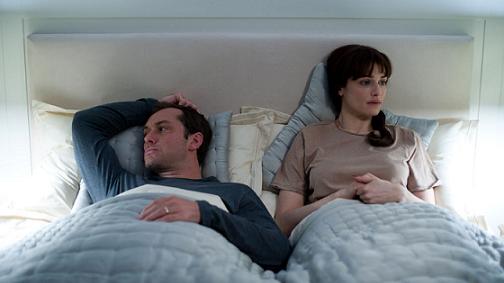
Jude Law and Rachel Weisz star in Fernando Meirelles's "360"
This year’s London Film Festival launched with a damp squib in the form of 360, Fernando Meirelles’ latest feature. How far Merielles seems now from City of God (2002). Set in Rio’s slums which force children to grow up fast, City of God was urgent, both socially and stylistically. Children taken from the street played roles which they knew all too well, and one particular scene of gun violence between children was heartbreaking and unforgettable.
360, by contrast, seems to have been inspired by two banal observations: first, in an age of easy international travel, there are a lot of opportunities for us to cross paths with people—so much so, everyone may be connected to everyone else. Hence the film’s title, though in truth the characters’ relationships do not form a circle: it is more a case of degrees of separation from a central character (a prostitute). The film’s second observation is that small choices made by different people every day must influence who meets whom, so a different choice on the part of just one person could alter events significantly. The notion of different paths to choose from is introduced early on by an appropriately goofy quotation from baseball player Yogi Berra: ‘When you come to a fork in the road, take it!’ As if once were not enough, the quotation is repeated at the end of the film, when a new prostitute appears on the scene, apparently starting a set of branched relationships all over again.
There have been a number of films about overlapping lives and the impact of small decisions: Babel (2006), for instance, and Sliding Doors (1998). The former film had a powerful social message about globalisation, while the latter was interesting for playing out in parallel the two different lives a character could live, as the result of catching a train or missing it. 360 just doesn’t justify itself in the same way.
Meirelles’ style does offer a few surprises, though they mainly come across as quirky or baroque rather than compelling. There is some snappy editing and sudden transitions that recall City of God, but with less motivation for the level of speed. More innovative flourishes include an airplane which takes off in one shot, then continues to fly through following shot, circling the head of a character obsessed by one passenger on the plane. There is also a shot which cleverly incorporates a split screen to make it look as though a sinister character on the phone is present in the apartment of the woman he is speaking to.
Without spoiling the suspense that is one of the mild pleasures of this film, I can say that 360 is a story of love and lust, as well as a tale of crossing paths, making decisions, and seizing the day: it is based on Arthur Schnitzler’s 1897 play La Ronde. The film boasts a strong cast of international stars from Britain (Anthony Hopkins, Jude Law and Rachel Weisz), France (Jamel Debbouze) and Austria (Mauritz Bleibtreu), but the script gives them little to work with and, as a result, it is difficult to become genuinely involved in the story. Most of the characters live in affluent or somewhat less affluent EU capitals (London, Paris, Vienna, Bratislava) and are by and large bourgeois. A pimp, a gangster and a sex offender are thrown into the mix for some much needed tension. Unfortunately, all of the characters are clichéd and one-dimensional. What clear traits they do have are routinely undermined by stupid decisions, which aren’t easily justified by the film’s other banal mantra: ‘You only live once: how many chances do we get?’ When poorly defined characters make such obviously idiotic choices, it is difficult to care what happens to them. Worse for the viewer, these bad decisions never have the exciting consequences they would normally have in other films (Thelma and Louise, for example).


